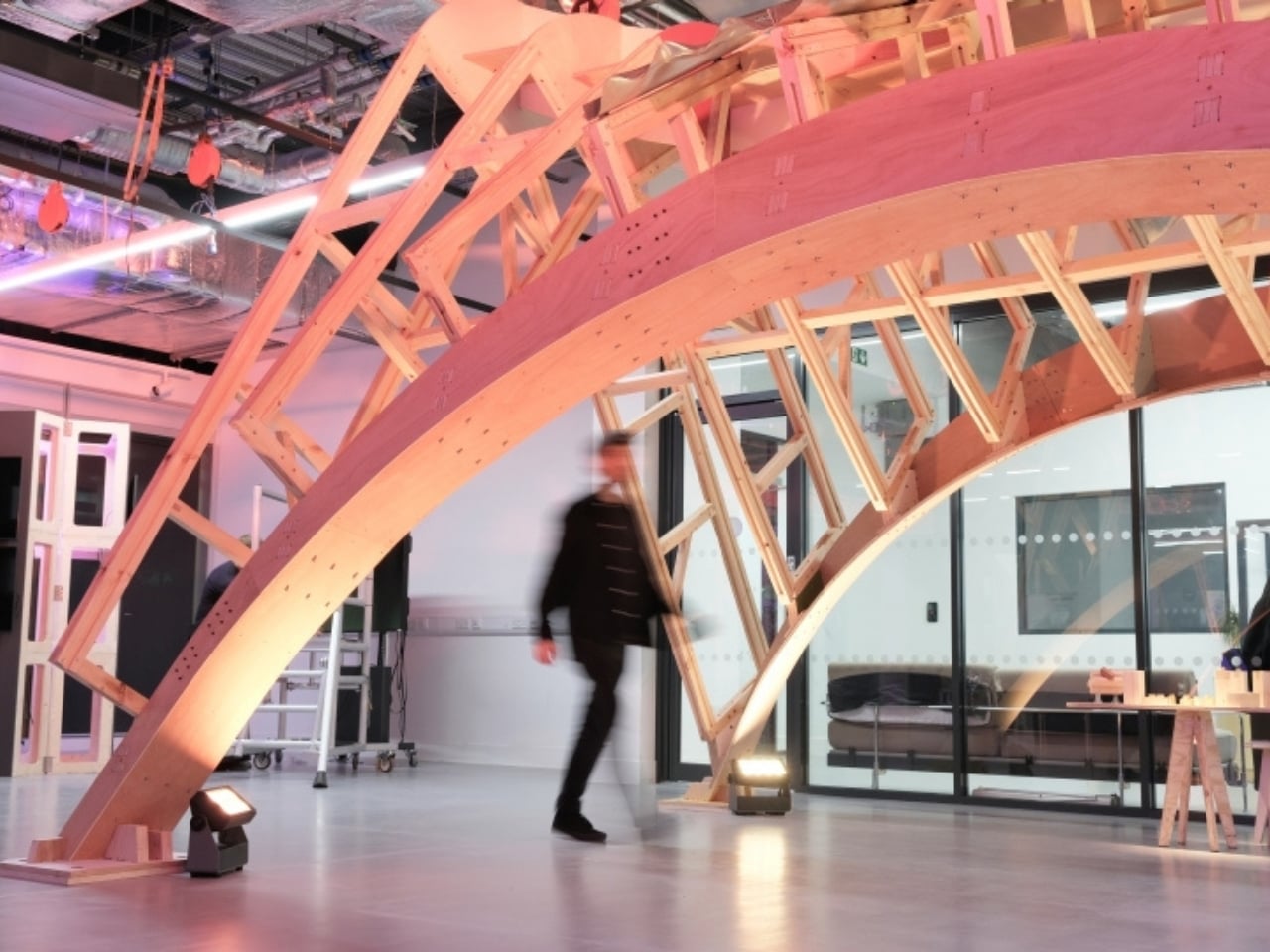
Arkhive is a timber pavilion assembled entirely by industrial robotic arms and designed by students from University College London's Design for Manufacture program. Every component is modular and connected using reversible joinery instead of nails, screws, or adhesives, enabling repeated disassembly and reassembly without material loss. The system prioritizes adaptability and permanence avoidance, allowing structures to be reconfigured into different forms and uses rather than being demolished and landfilled. Robotic fabrication provides precision and repeatability beyond human assembly. The approach aims to reduce construction waste, extend material lifecycles, and combine sustainable design principles with advanced manufacturing techniques.
"Picture this: a wooden structure that looks like it could be straight out of a sci-fi movie, assembled entirely by industrial robotic arms with precision that human hands simply can't match. But here's the kicker. This isn't just another flashy tech demo. Arkhive was created by students from University College London's Design for Manufacture program, and it's tackling one of construction's biggest problems: waste."
"The magic happens through something called reversible joinery. Instead of nails, screws, or adhesives that permanently bind materials together, these connections can be undone and redone as many times as needed. The timber components fit together in a modular system that prioritizes adaptability over permanence. So when the structure has served its purpose in one location or configuration, it doesn't become yesterday's trash. It becomes tomorrow's building material for something entirely new."
"Think about how we typically build things. We design them, construct them, use them for a while, and then when we're done, we tear them down and haul the debris to a landfill. It's a pretty wasteful cycle when you actually stop to consider it. Arkhive flips that script entirely. Every single component of this pavilion can be taken apart and reassembled into completely different configurations without losing any material. It's like architectural Lego blocks, but way more sophisticated."
#timber-construction #robotic-fabrication #reversible-joinery #modular-architecture #sustainable-design
Read at Yanko Design - Modern Industrial Design News
Unable to calculate read time
Collection
[
|
...
]