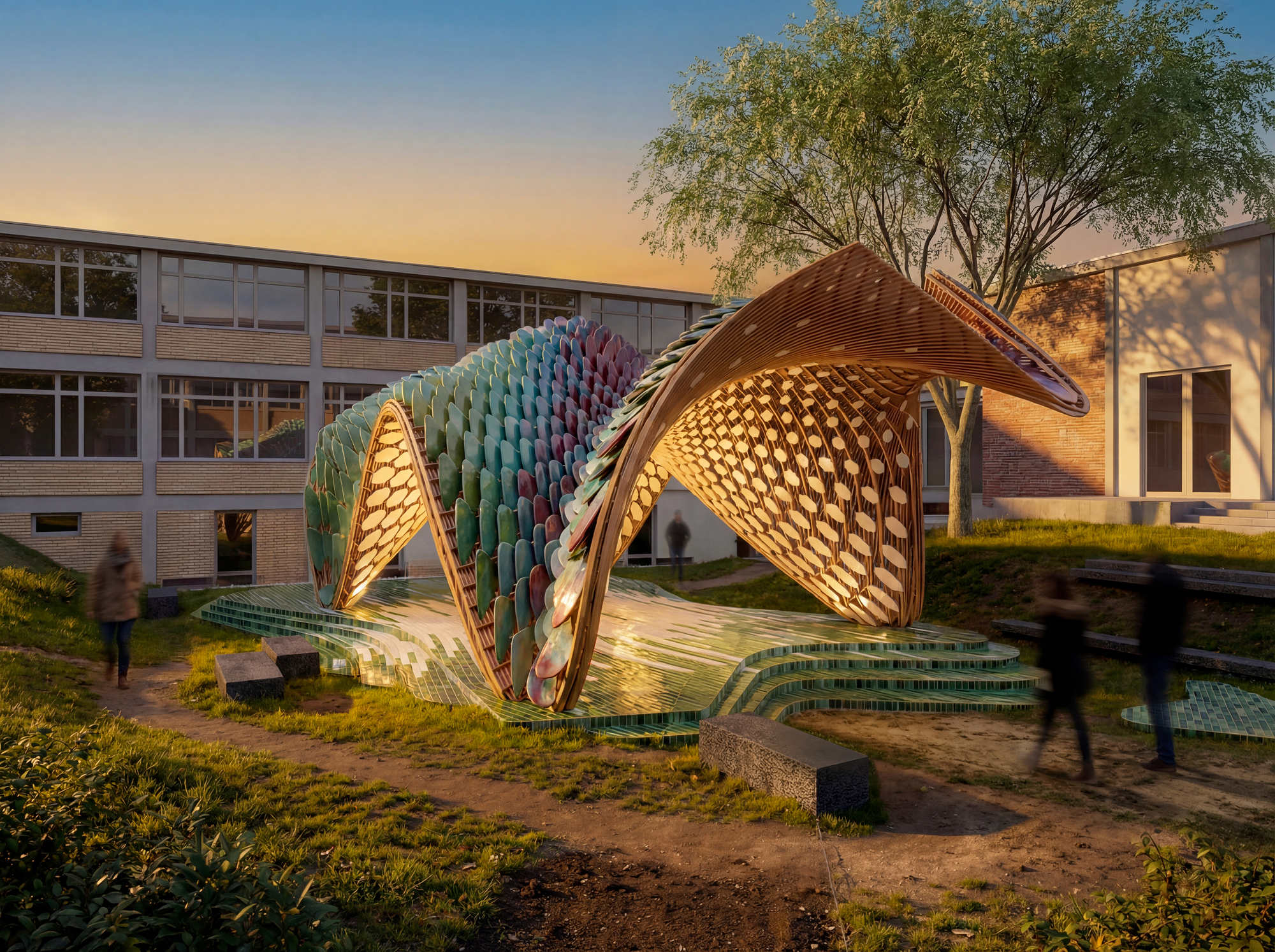
"Spain's pavilion for World Design Capital Frankfurt Rhein-Main 2026 positions itself as more than a temporary installation, exploring how a reversible cultural infrastructure can activate public space without permanent construction."
"The pavilion combines wood, ceramics, and textile solutions, featuring an organic and continuous geometric design that aligns with the principles of the New European Bauhaus."
"Materiality defines the project, with a wooden structure using a hybrid envelope of ceramic elements that provide texture, durability, and depth, along with textile components that modulate light and interaction."
Spain's pavilion for World Design Capital Frankfurt Rhein-Main 2026 serves as a dynamic cultural space rather than a temporary installation. It focuses on materiality, exploring reversible infrastructure that activates public spaces without permanence. The design reflects cultural contexts and historical influences, drawing inspiration from Antoni Gaudí. The pavilion, designed by José Ramón Tramoyeres and Javier Cortina, utilizes wood, ceramics, and textiles, embodying sustainability and precision. Its dismantlable and reusable structure aligns with the New European Bauhaus principles, integrating social dimensions into a model of circular architecture.
Read at ArchDaily
Unable to calculate read time
Collection
[
|
...
]