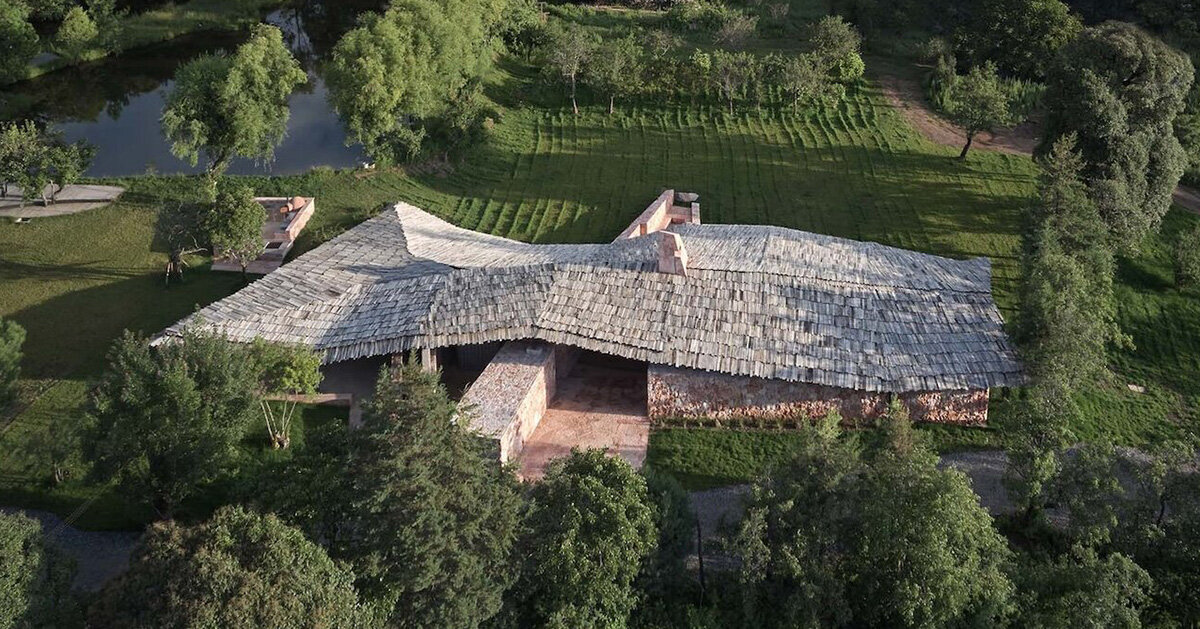
"The Hylla Cloud Nature Experience Center, also known as the 'Red House', is a nature experience center designed by . It sits on a gentle slope in Yanjiao Village, Baisha Town, Lijiang, Yunnan Province, . The hospitality project forms part of Hylla Land and offers a place for rest, gathering, and immersion in nature."
"Snow-covered mountains rise on one side, while the village and farmland extend on the other. Three sides of the site sit within a dense canopy that extends from Mount Zhishan. Lawns, water pools, and trees shape the foreground, while a natural canal runs behind the building and separates it from the main hotel across the water. Because of this setting, the architect chose to reinterpret the idea of 'local' architecture. Instead of repeating familiar forms, the design allows a relaxed structure to grow directly from the land."
"Yunnan carries a strong sense of calm, and its traditional buildings reflect this feeling. Local craftsmen once built without strict drawings or fixed rules. They worked with instinct and imagination and placed stones into walls freely, leaving edges unfinished. This approach valued chance and comfort over perfection. Because of this, the studio decided to design with the same relaxed attitude. Lijiang's weather remains sunny for most of the year. Clouds create moving shade across the land. Therefore, the cloud became a symbol of freedom and ease. This idea shaped the entire project."
Hylla Cloud Nature Experience Center sits on a gentle slope in Yanjiao Village, Baisha Town, Lijiang, Yunnan Province as part of Hylla Land. The facility provides spaces for rest, gathering, and immersion in nature and adapts to uneven terrain inspired by Kaare Klint's 1933 safari chair. Snow-covered mountains, village farmland and a dense canopy frame the site, while lawns, water pools and a natural canal shape the foreground and separate the center from the main hotel. The design reinterprets local architecture by favoring a relaxed, instinctive building approach and by unifying the scheme with a floating, cloud-like free-form roof.
Read at designboom | architecture & design magazine
Unable to calculate read time
Collection
[
|
...
]