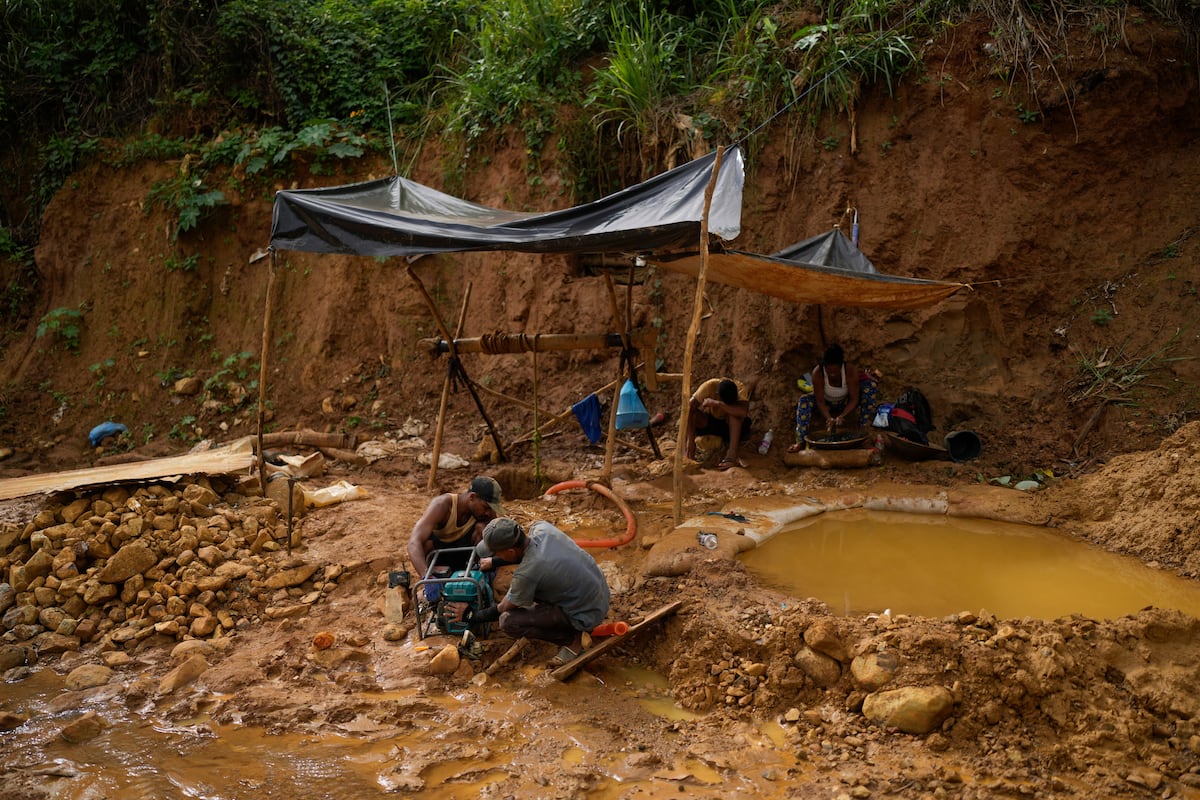
Italo Pizarro, a teacher and Indigenous Pemon community leader in San Miguel de Betania, lives near mines in Sifontes, an area with high malaria transmission. He has had malaria five times, and a five-year-old student has malaria for the eighth time while her mother has it for the fifteenth. Malaria is transmitted by infected Anopheles mosquitoes carrying Plasmodium parasites. Plasmodium vivax has been the main cause in Venezuela, but Venezuelan scientists identified Nyssorhynchus rondoniensis as an efficient vector capable of carrying Plasmodium falciparum. Only just over 1% of mosquitoes are infected with P. falciparum, and the source may have existed for years, previously misidentified. Molecular techniques confirmed the mosquito’s presence in Venezuela, where it had been recorded only in western Brazil until recently.
"Italo Pizarro is a teacher and leader of the Indigenous Pemon community of San Miguel de Betania. He has never been a miner, but he lives surrounded by mines in the Sifontes municipality of Bolivar state, Venezuela one of the epicenters of both mining activity and malaria transmission in the country. He has had malaria five times, most recently in 2015, 2016, and 2017. Now the disease is once again a concern: one of his fiveyearold students has malaria for the eighth time, and her mother for the fifteenth."
"Malaria is a disease mainly transmitted through the bite of an Anopheles mosquito infected with one of the five parasite species that cause it. Plasmodium vivax, one of the less aggressive types, has been the main cause of malaria in Venezuela. However, in recent years, a group of Venezuelan scientists has identified in Sifontes the mosquito Nyssorhynchus rondoniensis, another efficient vector capable of carrying the parasite Plasmodium falciparum the strain responsible for the highest rates of illness and death from malaria worldwide."
"There is no immediate cause for alarm. Just over 1% of the mosquitoes are infected with P. falciparum. Moreover, as Maria Eugenia Grillet, a biologist and lead researcher on the study, explains, this source of malaria in Venezuela is not entirely new. It is possible that the Ny. rondoniensis mosquito has been there for years, feeding mainly on animal blood, and that we were misidentifying it. But now, with molecular techniques, we have been able to get a better understanding of its taxonomy."
"This is how researchers were able to recently confirm the presence of this mosquito in Venezuela despite the great geographical distance, it had previously been recorded only in western Brazil, in the states of Acre and Rondonia, where it was first identified in 2022 by a group of Brazilian scientists led by Maria Anice Mureb. In that case, the mosquito was not infected. Jorge Moreno, a field entomologist specializing in malar"
Read at english.elpais.com
Unable to calculate read time
Collection
[
|
...
]