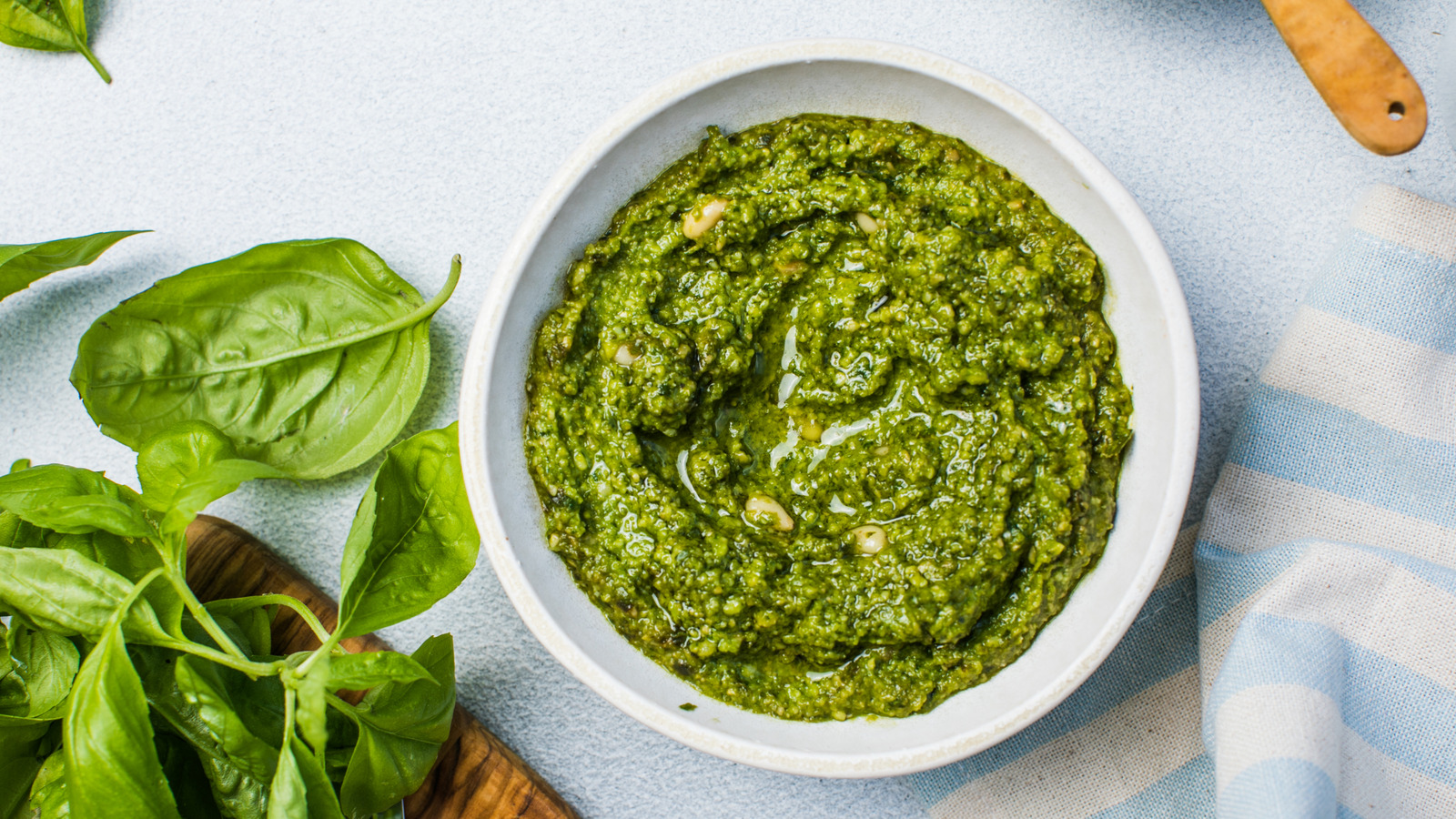
A bright emerald green color signals well-made pesto. Pesto's few ingredients leave little room to mask mistakes. High-speed blenders liquefy and bruise basil leaves, dragging in air that accelerates oxidation and browning. Blender blades create frictional heat that breaks down fragile chlorophyll and volatilizes essential oils, producing a flat, metallic flavor. Herbaceous, leafy sauces like pesto, salsa verde, and chimichurri benefit from compression rather than high-velocity processing. The mortar-and-pestle method crushes leaves to extract flavor while preserving structure. When using a blender, intermittent pulsing helps achieve a rougher, less destructive texture.
"High-speed blenders are built to liquefy, not mince around or preserve, and when tender basil leaves meet sharp blades with that kind of force, the mixture goes dark. The leaves bruise instantly, and the motion of the machine drags in so much air that the brown-ifying process of oxidation starts right before your eyes, before you've even taken the lid off to scrape down the sides."
"Basil's chlorophyll is fragile and breaks down under heat, and blenders run hot, because they create friction energy. Even when the base of the machine stays cool to the touch, the blades generate enough friction to warm the sauce as it forms. The essential oils that give basil its sharp flavor are also sensitive, and once they volatilize, they start to dissipate, which causes that flat, vaguely metallic flavor profile."
"Some ingredients need old-school compression, not high velocity. Herbaceous, leafy sauces like pesto, salsa verde or fresh chimichurri sauce all prefer to be more roughly hewn. That's why the classic, low-tech mortar-and-pestle method is the gold standard tip for making the best pesto, because it respects the structure of the leaves, crushing them to draw out the flavor, without utterly annihilating them. If you must use a blender, use the popular "pulse" setting to get there more in fits and starts, roughly and slowly."
Read at Tasting Table
Unable to calculate read time
Collection
[
|
...
]