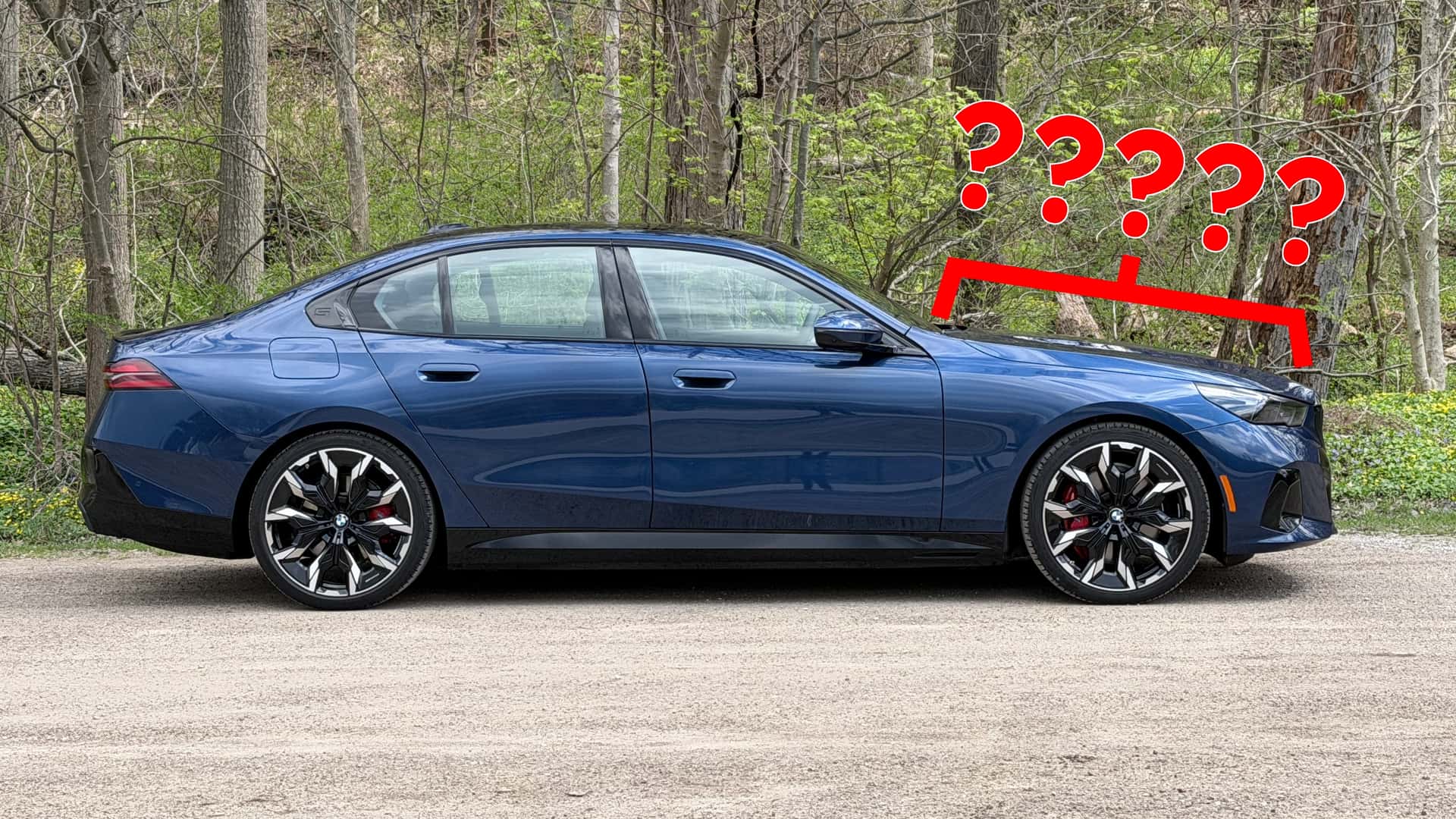
"The i4 is wonderful, the i7 is sumptuous, and the i5 I'm driving this week is a competent and impressive daily driver. But these cars are good in spite of their shared underpinnings, not because of them."
"The i5's hood area is stuffed with power electronics and HVAC components. Fair enough, those have to go somewhere. But let's take a look at the alternative: The Model 3's hood is a lot shorter, but Tesla manages to squeeze a drive motor, the power electronics for the vehicle, the HVAC system, and a user-accessible frunk under it."
"Because of the packaging advantages of a purely electric, software-defined platform, the Model 3 also squeezes a frunk under its hood, giving you an extra 3.1 cubic feet of storage space."
BMW's i4, i5, and i7 electric sedans are surprisingly good vehicles, despite being built on shared platforms with gas-powered models. The i5, for instance, has a long hood that houses power electronics and HVAC components, which limits its design efficiency. In contrast, Tesla's Model 3 features a shorter hood that accommodates a drive motor and power electronics while also providing additional storage space. This comparison highlights the advantages of dedicated electric platforms over traditional shared designs in maximizing vehicle functionality and efficiency.
Read at insideevs.com
Unable to calculate read time
Collection
[
|
...
]