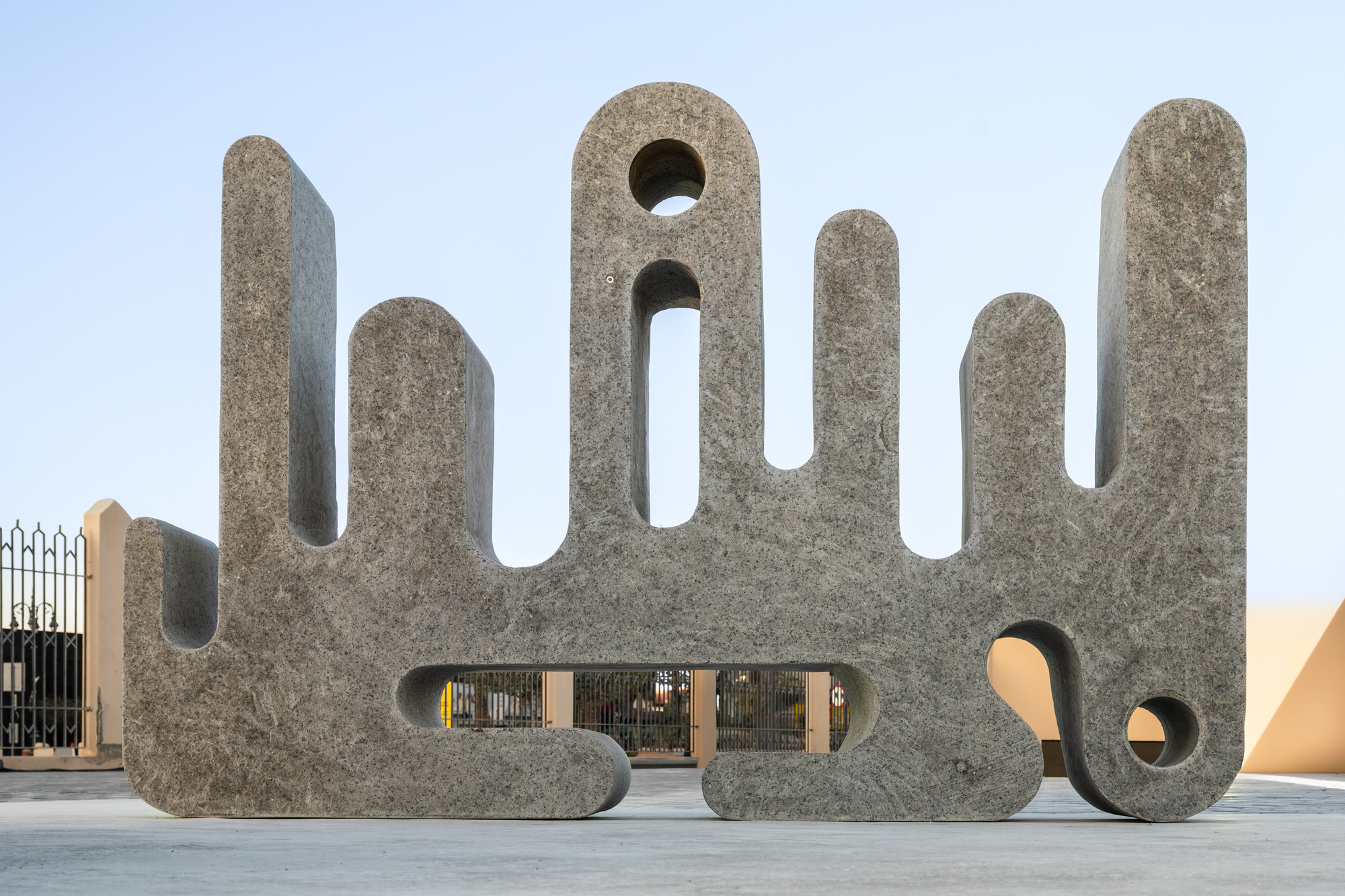
Sculpture has evolved from representing religious values and political power to become a critical instrument for urban transformation and public space engagement. Contemporary works interrogate the present, challenge scale, and reshape perceptions of cities. Riyadh exemplifies this transformation through its Vision 2030 agenda, investing in public spaces and cultural production to redefine urban experience. Tuwaiq Sculpture 2026, the seventh edition of the symposium, presents 25 large-scale sculptures created live along Tahlia Street from January to March. Curated by Sarah Staton, Rut Blees Luxemburg, and Lulwah Alhomoud, the event operates as an open-air laboratory where artists transform locally sourced materials into artworks, integrating artistic practice into the urban environment and contributing to the city's symbolic redefinition.
"Today, it also operates as a critical instrument and an urban mediator. Many contemporary works interrogate the present, challenge scale, engage with movement and circulation, and reshape perceptions of public space. Sculpture is no longer conceived as an isolated object, but as part of broader processes of urban transformation."
"Riyadh, the capital of Saudi Arabia, exemplifies a city undergoing intense expansion and restructuring. Particularly under the Vision 2030 agenda, it has invested in upgrading public spaces, diversifying its cultural landscape, and consolidating an urban identity that brings together tradition, infrastructure, and global projection."
"The event operates as an open-air laboratory where, between January 12 and March 8, the public was able to follow the creative process, observing artists transform locally sourced stone and reclaimed metal into artworks."
Read at ArchDaily
Unable to calculate read time
Collection
[
|
...
]