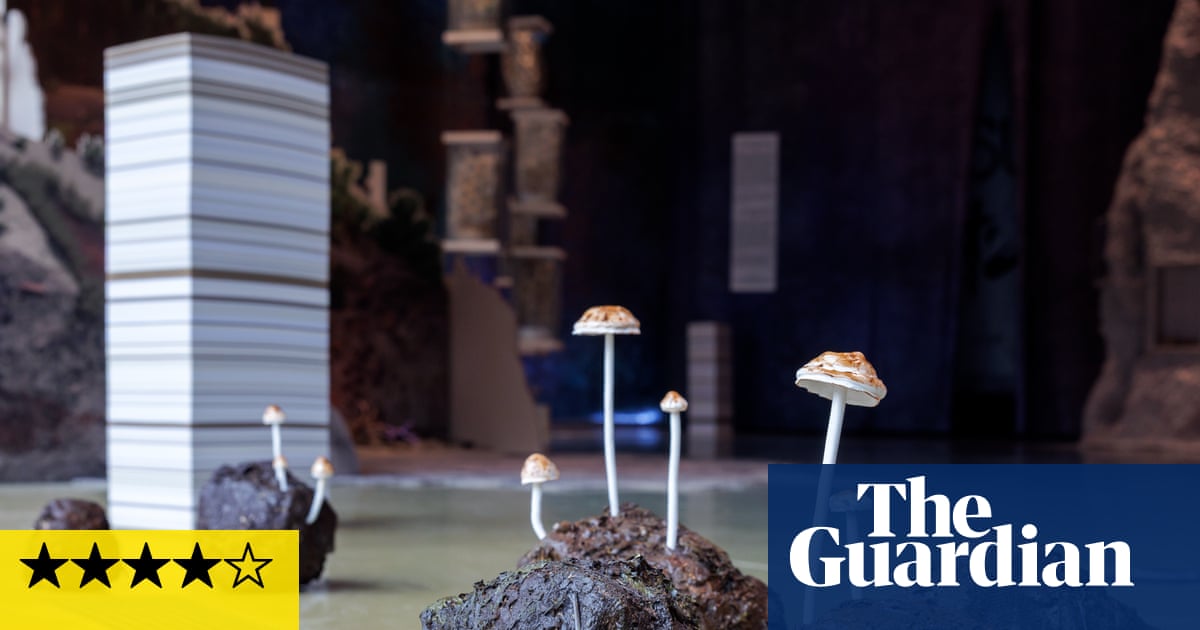
"Sylvia Plath's poem Mushrooms is a sinister paean to the natural world. Her observations on fungi are freighted with foreboding, noting how very / Whitely, discreetly, / Very quietly they Take hold on the loam, / Acquire the air. The poem ends: We shall by morning, / Inherit the earth. / Our foot's in the door. Plath's ominous ode from 1959 forms the opening salvo in an exhibition dedicated to fungi's creepy omniscience."
"A timelapse film of the aptly named basket stinkhorn, burgeoning from fleshy phallus into a perforated umbrella, sets the tone. The stinkhorn emits the smell of rotting flesh to attract flies, which feast on it and disperse its spores. Fungi refuse the commands of human masters and to abide by human standards of propriety, say the exhibition's curators, anthropologist Anna Lowenhaupt Tsing and architect and artist Feifei Zhou."
Sylvia Plath's poem Mushrooms frames fungi as quietly conquering forces that will inherit the earth. An exhibition titled Fungi: Anarchist Designers uses installations, films and soundscapes to dramatize fungal ubiquity, resilience, reproduction, spread, evolution and annihilation. Works depict fungi thriving on discarded, dead and dying matter, driving cycles of decay and regrowth and acting as coprophiliacs, necrophiliacs and silent assassins. A timelapse of the basket stinkhorn shows its fleshy, phallic growth and rotting-flesh odor that attracts flies to disperse spores. Curators Anna Lowenhaupt Tsing and Feifei Zhou emphasize fungal refusal to submit to human control and their role in agricultural and medical crises.
Read at www.theguardian.com
Unable to calculate read time
Collection
[
|
...
]