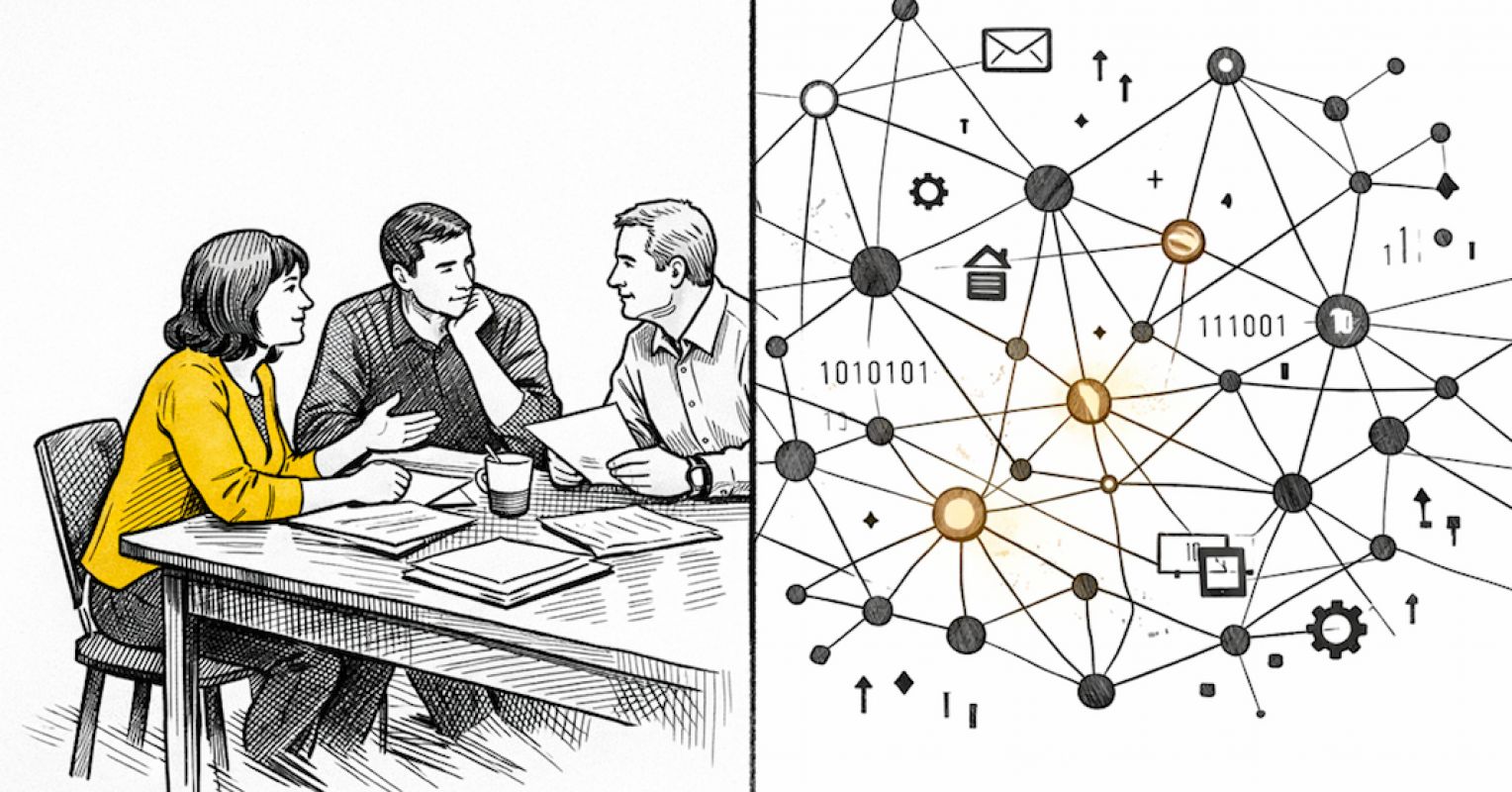
Human collaboration relies on individual minds and performs best in small teams that balance diversity and coherence. Beyond small sizes, cognitive limits, social friction, and divided attention reduce effectiveness. Large language models change those conditions by enabling exhaustive idea exploration without human downsides, removing the ceiling on group size. Agentic AI systems are emerging that can initiate tasks, exchange information, and adapt strategies, enabling coordination that no longer centers humans. As coordination externalizes to computation, human judgment risks deference to automated coordination and governance processes. Mitigating this requires attention to how authority and oversight shift with externalized coordination.
"A couple of years ago, I wrote about something I called the techno-agora. It's a way of thinking about how large language models were beginning to reshape group collaboration. At the time, the idea felt speculative, even a bit architectural. My central point was that human collaboration has natural limits. And LLMs change those limits by altering how ideas are generated and sustained across groups. But let's take a step back."
"Large language models altered collaboration by changing the conditions under which it can grow. Human group optimization tends to peak in small clusters-often no more than a handful of minds-before the reality of costs, social friction, and divided attention begins to erode insight and productivity. When language models work together on a task, that ceiling disappears. Ideas can be explored exhaustively without the human downsides."
"What we're seeing now isn't simply an evolution of human collaboration, but the emergence of collaboration that no longer requires humans at the center. The techno-agora has evolved from a space where humans and AI think together into one where AI systems increasingly coordinate among themselves. The rise of agentic systems -AI agents that can initiate tasks, exchange information, and even adapt strategies"
Read at Psychology Today
Unable to calculate read time
Collection
[
|
...
]