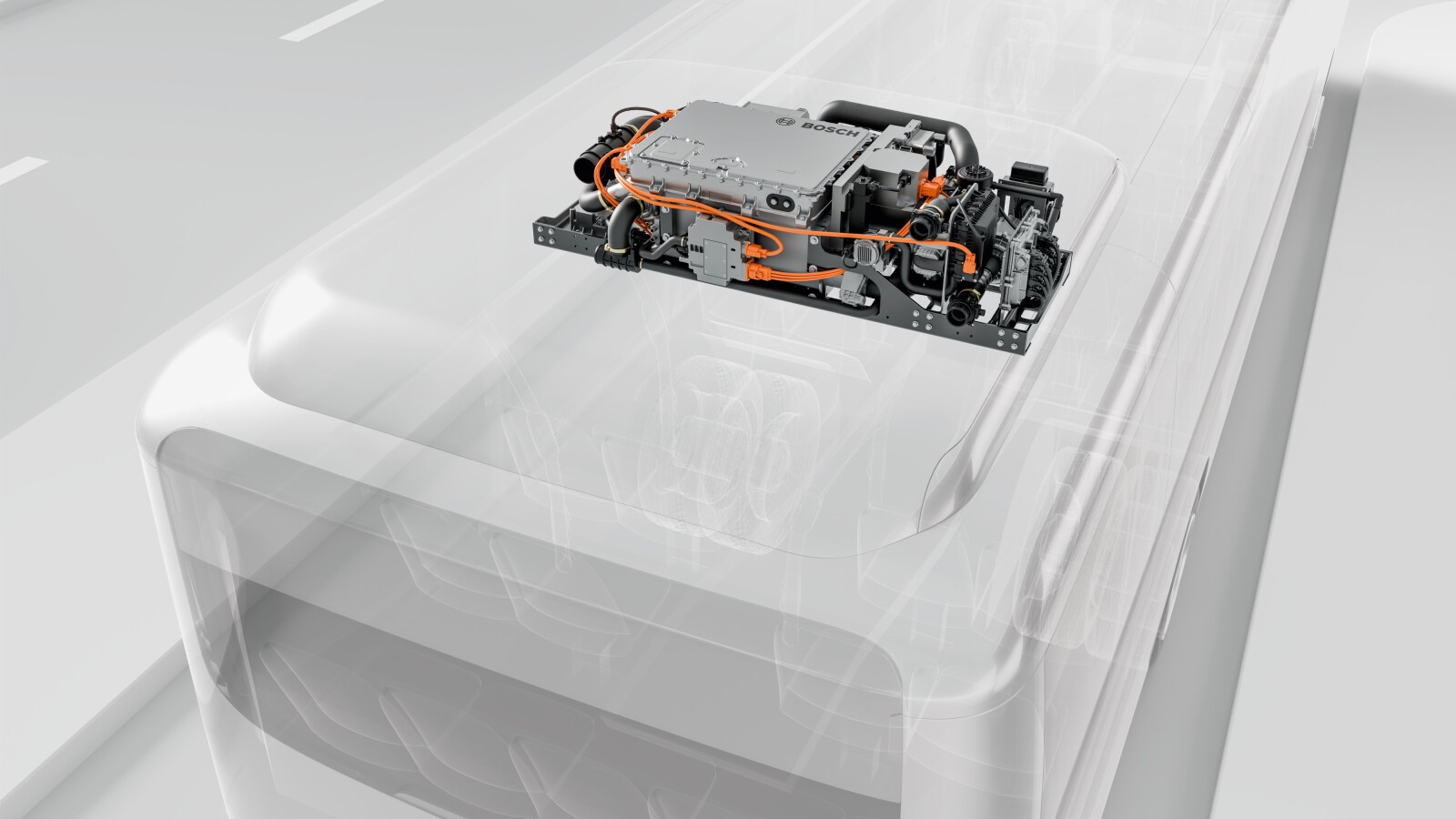
"The newly introduced Bosch FCPM C100 is designed specifically for city buses operating in the European market, where fuel cell applications are covering at the moment roughly 5 percent of the BEV bus sales ( standing last year at over 11,000 units)."
"The module features a flat architecture with a height of approximately 40 centimetres, enabling installation on the roof of the vehicle, a configuration commonly used for urban bus platforms. The system is intended for buses between 12 and 18 metres in length and integrates standard communication and diagnostic interfaces including CAN connectivity."
"The C100 expands the company's FCPM product family, which covers power outputs from 100 to 300 kilowatts. The module presented in Berlin represents the lower end of the power range, targeting urban public transport applications with moderate power requirements."
Bosch introduced the FCPM C100 fuel cell module at Mobility Move in Berlin, a compact hydrogen propulsion system specifically designed for city buses in the European market. The module features a flat architecture approximately 40 centimeters in height, enabling roof installation on urban bus platforms. It targets buses between 12 and 18 meters in length and integrates standard communication interfaces including CAN connectivity for straightforward integration into existing vehicle architectures. The C100 represents the lower end of Bosch's FCPM product family, which ranges from 100 to 300 kilowatts. The architecture derives from the FCPM C190 variant for intercity buses and coaches, with Bosch planning demonstration vehicle testing in the first half of 2026. The C300 variant serves heavy-duty applications including long-distance coaches and trucks.
Read at Sustainable Bus
Unable to calculate read time
Collection
[
|
...
]