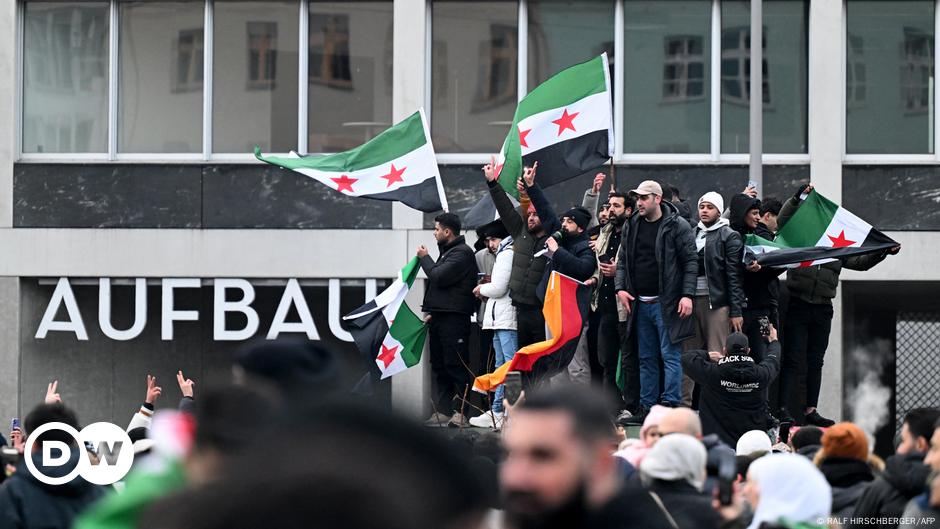
The European Union on Wednesday issued updated guidance for asylum applications by Syrian nationals that reflects new conditions in Syria a year after the fall of the Bashar Assad. The changes may influence the result of asylum requests of some 110,000 Syrians who were still awaiting an asylum decision at the end of September. The European Union Agency for Asylum said opponents of Assad and military service evaders are no longer at risk of persecution.
Highland council said the play, called Gimme, Gimme, Gimme, would not go ahead after negative feedback on social media and abusive messages directed at the school and its staff. Made by Edgy Productions, which specialises in scripts and music for schools and youth theatre, the show featured a scene in which Santa shows two young people the hardships faced by Syrian refugees on the Turkish border.
A total of 1,906 initial asylum applications from Syrians were rejected in October, compared to 163 during the period from January to September, statistics from the Federal Office for Migration and Refugees (BAMF) showed on Saturday. The figures come as BAMF resumed processing "young, able-bodied" male Syrians' asylum requests at the end of September after suspending almost all such decisions last December following the change in government in Syria. "In justified individual cases, the Federal Office has also issued full rejections against Syrian nationals," the BAMF said, referring to cases involving criminals and people considered to pose a potential danger.
The German government is determined to reach a deal with Damascus to accelerate the repatriation of Syrian war refugees, despite concerns about the humanitarian situation in a country where violence continues and the economy and infrastructure have been devastated. In late September, Germany Interior Minister Alexander Dobrindt told the Rheinische Post newspaper that he intended to "reach an agreement with Syria this year and then initially deport criminals and later people without residence permits." But that might be easier said than done, for both legal and humanitarian reasons. "Syria is at its limit; its capacity to take in refugees has already been exhausted," Gonzalo Vargas Llosa, director of the United Nations refugee agency (UNHCR) in Syria, told the Suddeutsche Zeitung newspaper last week.
The face of a Syrian refugee is the enigmatic key to this slow-burning drama-thriller, the fiction feature debut of French film-maker Jonathan Millet; it is hard, blank, withdrawn, yet showing us an inexpressible agony, a suppressed, unprocessed trauma, complicated by what is evidently a new strategic wariness. The refugee is Hamid (played by Adam Bessa), a former literature professor from Aleppo who is now in Strasbourg in France in 2016,
Millet's new film, Ghost Trail, follows a Syrian refugee in Strasbourg as he attempts to locate the man who brutalised him in Sednaya prison, Damascus. Ghost Trail therefore joins the roll call of cerebral films that manufacture an uncanny power from what isn't depicted. But here, it's not achieved in exactly the same fashion as ones where the consequential action is cropped out of view.
Lawmakers from Chancellor Friedrich Merz's Conservative Democrats are calling for more to be done to make returning home a more attractive prospect for Syrians who have sought refuge in Germany.
Hardly a day goes by without a new insult being hurled in the faces of asylum seekers and refugees. We're scroungers, rapists, fighting-age men who shouldn't have left our home countries. Sometimes we're simply illegals, the most dehumanising term of all. When did it become a crime to run for your life? The people levelling these accusations are superb at making themselves heard. Mud sticks and most of us