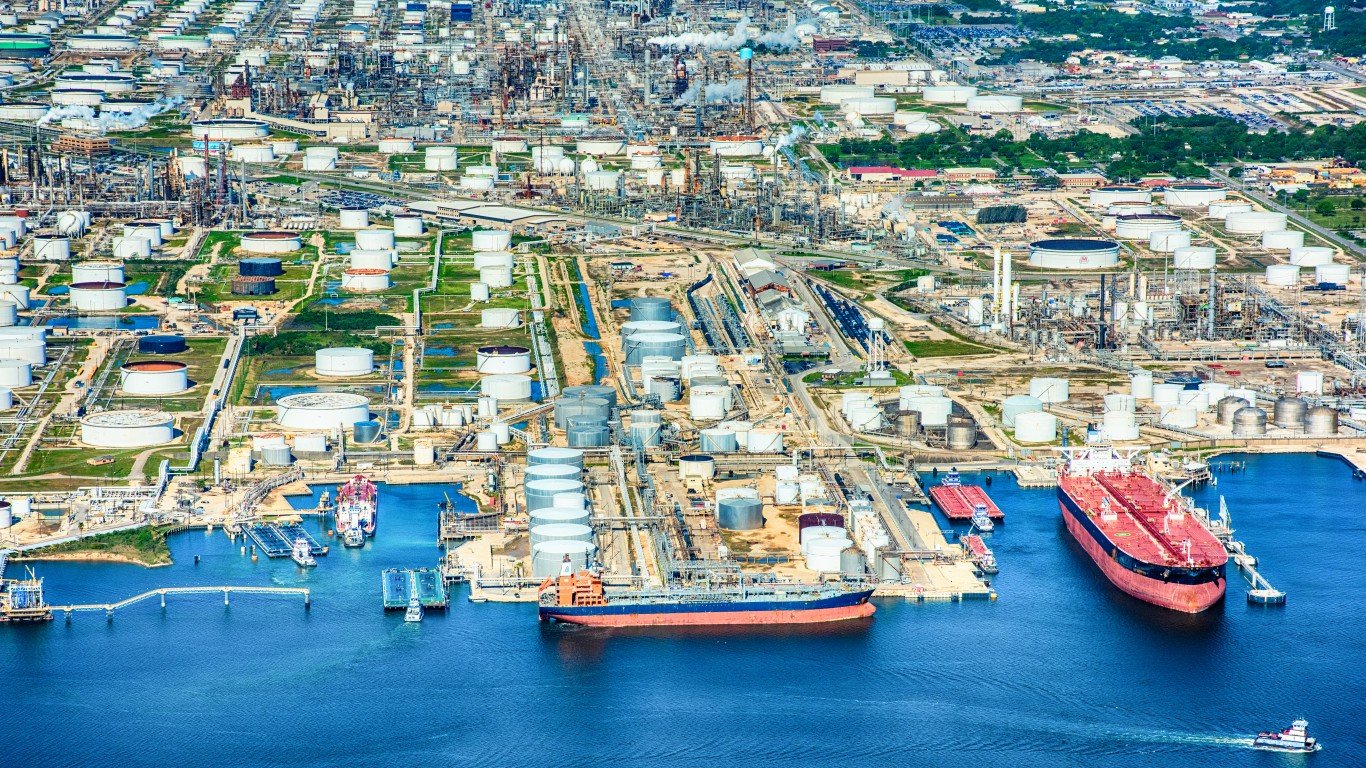
At the start of this year, Pakistan had more imported liquefied natural gas (LNG) than it could use, with demand falling from a peak of 8.2 million tonnes in 2021 to 6.1 million tonnes by late 2025. The government sold excess gas shipments to other countries and shut down domestic gas wells to prevent pipelines from bursting under oversupply.
The Strait of Hormuz - a narrow waterway through which roughly a fifth of the world's oil supply passes - has effectively closed to tanker traffic amid the escalating U.S.-Israeli strikes on Iran. Once again, the global economy is discovering the same uncomfortable truth: Modern energy security depends on supply chains that can break overnight.
TotalEnergies will abandon offshore wind projects deemed too big and expensive without federal subsidies in the U.S., opting instead for onshore wind, solar, and battery storage.
The United States - we produce more oil than we can consume. We're a net oil exporter," Wright said. This comment misses some important context. Some metrics show the U.S. as a net exporter, but for crude oil - the material that's refined into gasoline - the U.S. is a net importer.
Donald Trump is trying to make it easier for foreign tankers to move around the US, temporarily allowing foreign-flagged ships carrying oil and gas to travel between US ports, the White House announced Wednesday. The move comes as the president tries to manage a delicate balancing act, attempting to mitigate the increasing price of oil while also carrying out the US-Israel war on Iran.
At a meeting at the Paris headquarters of the intergovernmental body dedicated to global energy security, Wright referred to the "destructive illusion" of the IEA's commitment to massively reducing greenhouse gas emissions sourced from fossil fuels. The US, one of 45 member and associate countries of the IEA that represent 75% of the world's energy demand, is threatening to withdraw from the body if it does not quit its energy transition goals in the next year.
LPG-carrying ships Shivalik and Nanda Devi crossed the strait Saturday, marking a breakthrough in diplomatic talks between Iran and India. Both ships were escorted by the Indian Navy under 'Operation Sankalp,' launched to ensure the safety of Indian vessels in the Gulf. The world 'Sankalp' roughly translates to vow or determination.
But one key voice was missing from the celebration: Texas GulfLink's developer. Dallas-based Sentinel Midstream declined to comment on the administration's announcement, and didn't issue any press release for its politically ballyhooed project approval. Sentinel's silence was a symptom of a bigger disconnect in the gulf.What once was a race to build a series of deepwater terminals prior to the pandemic-including the involvement of household names such as Phillips 66 and Chevron-has now turned into silence over stalled projects that may never come to fruition.
A barge-based configuration offers advantages over land-based facilities, according to BDC, including optimization of scarce land resources through offshore or nearshore deployment, vital in a country that is smaller than many cities, including London. This arrangement also offers segregation between hydrogen handling infrastructure and the core datacenter operations, the firm says, plus greater flexibility in hydrogen transport and storage, making use of Singapore's maritime ecosystem.
January 2026 showed just how violent this relationship can get: Henry Hub spiked to $30.72/MMBtu on January 23 - a near-tenfold surge - before collapsing to $3.13/MMBtu by February 23. Extreme winter heating demand and supply constraints drove that move - exactly what BOIL is built to capture on the upside, and what devastates holders on the way back down.
Energy Transfer ( NYSE: ET) delivered a mixed fourth quarter 2025 performance, posting $25.32 billion in revenue while net income declined to $928 million, down from $1.08 billion year-over-year. The midstream giant reported $0.25 EPS and adjusted EBITDA of $4.18 billion, representing an 8% increase from the prior year quarter. Despite the earnings decline, Energy Transfer achieved multiple operational records.
Data centers have caused the demand for gas-fired power in the US to explode over the past two years, according to new research released Wednesday. More than a third of this new demand, the research found, is explicitly linked to gas projects that will power data centers -the equivalent of energy that would power tens of millions of US homes.
The US is leading a huge global surge in new gas-fired power generation that will cause a major leap in planet-heating emissions, with this record boom driven by the expansion of energy-hungry datacenters to service artificial intelligence, according to a new forecast. This year is set to shatter the annual record for new gas power additions around the world, with planned and under-construction projects earmarked for 2026 set to nearly triple the amount of existing gas capacity, a report by Global Energy Monitor (GEM) found.