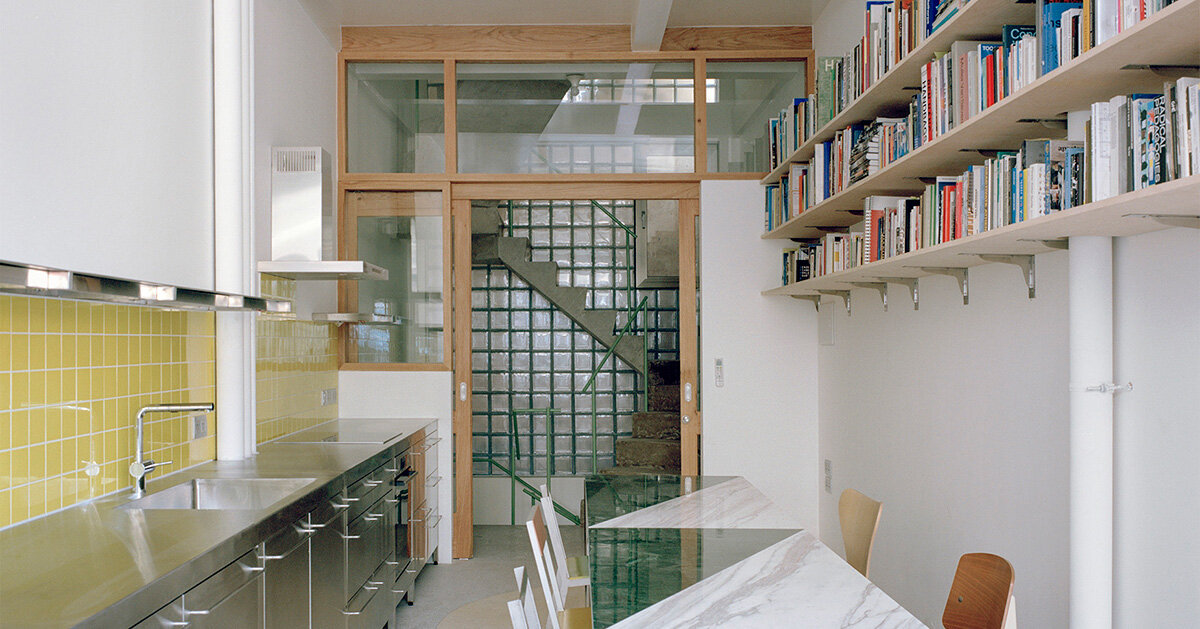
"Emerging in large numbers during Vietnam's construction boom of the 1990s, tube houses are defined by their narrow plots and deep plans, often resulting in dim and stuffy interiors. Exutoire reorganizes the core of the building and relocates the staircase, previously positioned at the center and acting as a spatial barrier, to the back of the plot and removes transverse partitions to open up each level, allowing light and air to travel freely through the depth of the house."
"Larger, continuous rooms replace compartmentalized floors, and the new open stairwell contributes to improved cross and stack ventilation, a passive strategy particularly relevant in Hanoi's humid subtropical climate."
"At the rear, a wall of glass bricks introduces diffused natural light deep into the plan while maintaining privacy in the dense urban fabric. New window openings and the repositioned stairwell enhance airflow, while the facade upgrade improves overall energy performance."
Exutoire completes a comprehensive renovation of 22YB1, an early-1990s tube house in central Hanoi measuring three meters wide by twelve meters deep. The project addresses chronic issues of darkness, poor ventilation, and thermal discomfort inherent to this post-Đổi Mới housing typology. The renovation relocates the staircase from the center to the back, removes transverse partitions to create larger continuous rooms, and implements passive ventilation strategies suited to Hanoi's humid subtropical climate. The ground floor functions as the architects' studio, continuing Vietnam's shophouse tradition, while upper levels accommodate multigenerational living. Design interventions include facade reconditioning, glass brick walls for diffused light, and new window openings that enhance airflow and energy performance.
#tube-house-renovation #hanoi-architecture #passive-ventilation-design #adaptive-reuse #urban-housing-typology
Read at designboom | architecture & design magazine
Unable to calculate read time
Collection
[
|
...
]