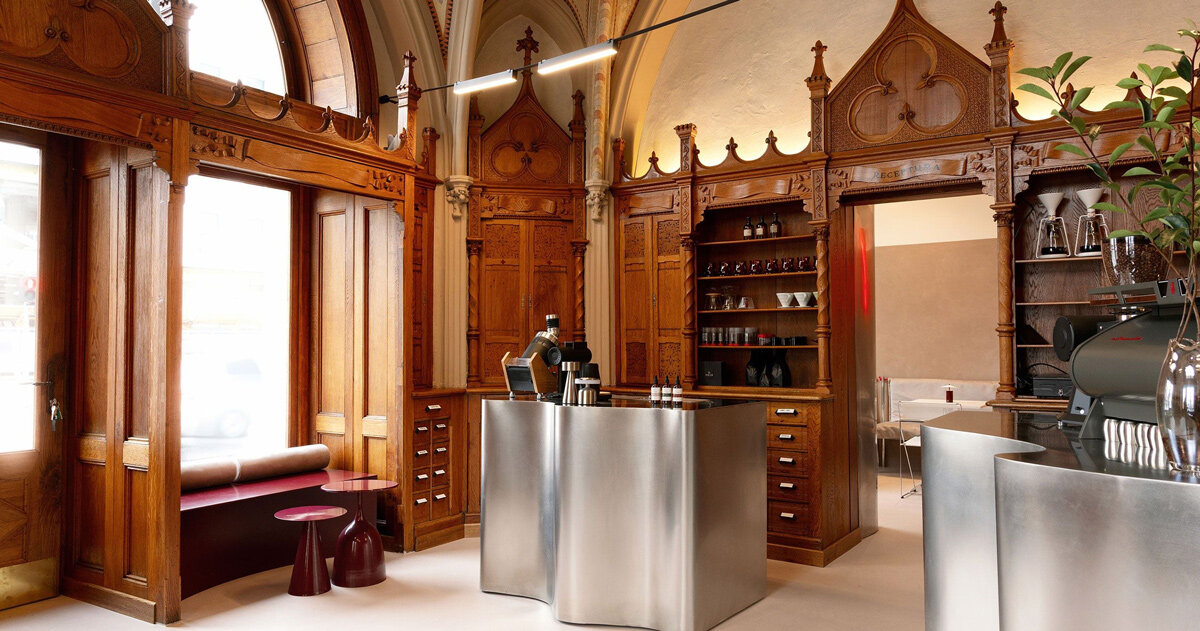
"Long before it was repurposed for Laboratorium, the Széki Palace was built in Cluj-Napoca, Romania as a pharmacy in 1893 by Hungarian architect Pecz Samu. The pharmacy occupied the ground floor, with production spaces and laboratories located below, while residential apartments filled the upper levels. Over time, the space retained an impressive portion of its original interior details, even as functions and ownership evolved across the twentieth century."
"Vaulted ceilings, pointed arches, and richly carved Neo-Gothic wooden cabinets define the character of the former apothecary. These cabinets, produced by cabinetmaker B. Bak Lajos, line the walls with a rhythmic density that gives the room both weight and order. EktraArhitectura and Fain Design approached these elements as the primary spatial framework, restoring them in collaboration with heritage specialists and allowing their presence to guide every subsequent design decision."
Laboratorium occupies the ground floor of the Széki Palace in Cluj-Napoca, reactivating a late-19th-century Neo-Gothic pharmacy while maintaining the building's historic urban presence. Vaulted ceilings, pointed arches, and richly carved wooden apothecary cabinets by B. Bak Lajos were restored and conserved in collaboration with heritage specialists. Contemporary interventions are restrained and subordinated to the original spatial framework, introducing a café program that respects original rhythms and materials. Production spaces and laboratories below, and residential levels above, remain part of the building's layered history. Daily public use is used to reactivate architectural memory and allow continued evolution.
Read at designboom | architecture & design magazine
Unable to calculate read time
Collection
[
|
...
]