"Haniyasu House by AATISMO overlooks a valley in Kamakura, Japan, a place shaped by earthen cliffs which hold rows of ancient cave tombs carved into the rock. The area carries a dense geological and cultural presence, and the house answers that weight with a low, grounded profile that follows the slope of the land and keeps close contact with soil and stone."
"Designed for the architects themselves and their parents, both ceramic artists, the renovated dwelling supports two generations whose lives center on clay. Domestic life and making share the same territory, and the project treats this overlap as the starting point for every spatial decision. Rooms, work areas, and outdoor zones interlock so that firing, glazing, cooking, and resting occur within an open plan rather than in isolated rooms."
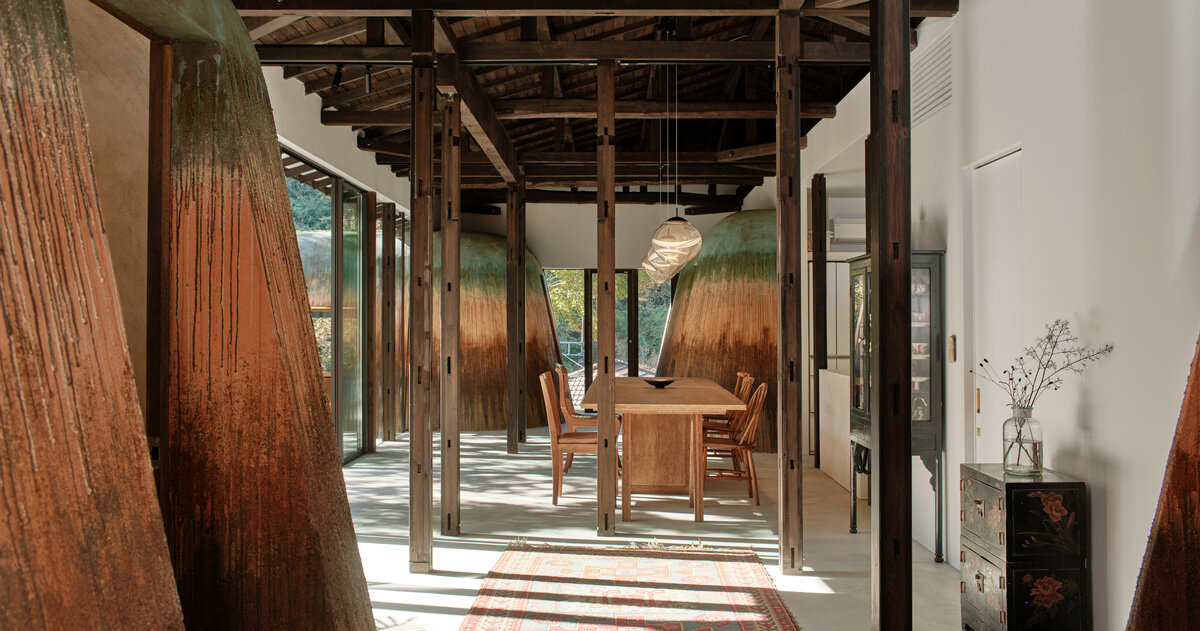
"The Haniyasu House renovation by AATISMO began with a modest single story wooden structure built in 1967. All interior walls and ceilings were removed, opening the plan into a single volume that connects directly to the surrounding garden and sky. Into this open core, new rooms were inserted at the four corners. Their compact, heavy forms read as earthen masses rising from the ground, giving the composition the character of a small settlement gathered around a shared center."
Haniyasu House in Kamakura sits on a slope of earthen cliffs holding ancient cave tombs and employs a low, grounded profile to maintain close contact with soil and stone. The renovated single story 1967 wooden house removed interior partitions to form one open volume that connects to the garden and sky. New compact rooms were inserted at the four corners as heavy, earthen masses, creating a central common plaza for meals, work, and daily life. The plan interlocks domestic, making, and outdoor activities so firing, glazing, cooking, and resting occur within shared space. Plaster, soil, and timber textures and shifting daylight produce a calm, tactile atmosphere.
Read at designboom | architecture & design magazine
Unable to calculate read time
Collection
[
|
...
]