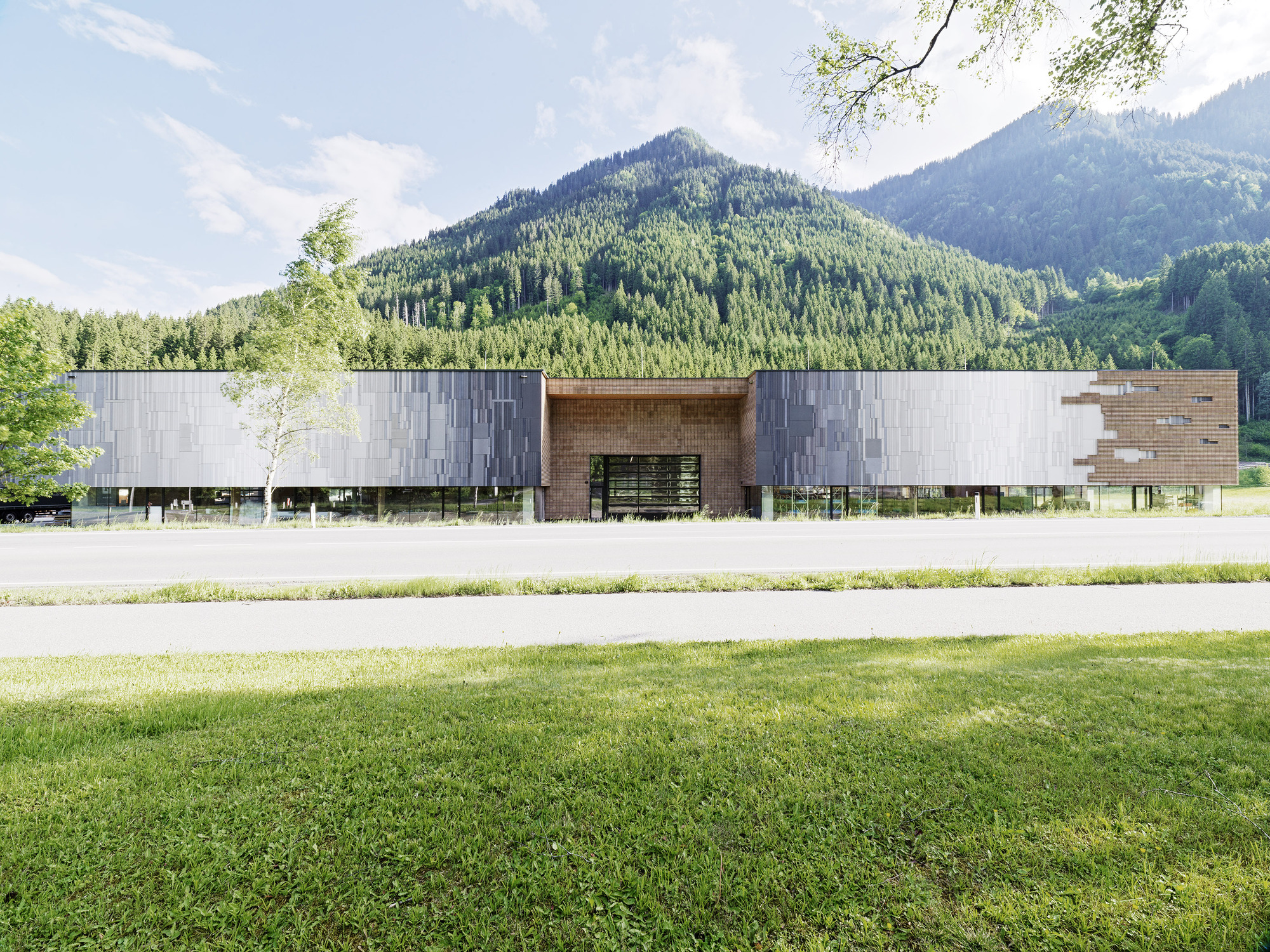
"At Rieder's headquarters in Maishofen, Austria, over 1,300 cubic meters of timber, 180 ceiling elements, and hundreds of upcycled glassfiber-reinforced concrete fragments come together in a building shaped as much by reuse as by planning. The new production hall, designed by Kessler² Architecture, treats material leftovers as a design resource. Developed as part of a long-term investment in sustainable manufacturing, the timber-concrete hybrid building introduces a facade technique that inverts conventional architectural workflows: instead of designing first and producing components afterward,"
"The project expands Rieder's production capacity while reinforcing its role as a testing ground for material research and construction methods. For a company that has spent nearly two decades developing glassfiber-reinforced concrete (GRC) facade systems, the new hall serves both as operational infrastructure and an example of integrating material efficiency, digital workflows, and spatial quality. A Timber-Concrete Hybrid for Industrial Production The hall was designed with employee comfort and operational efficiency in mind. Natural light, air quality, and spatial comfort were prioritized from the outset."
Rieder's new production hall in Maishofen, Austria repurposes over 1,300 cubic meters of timber, 180 ceiling elements, and hundreds of upcycled glassfiber-reinforced concrete fragments as primary building materials. Kessler² Architecture produced a timber-concrete hybrid structure that places wood and concrete where each material performs best, balancing structural robustness and fire protection. The building envelope was generated from on-site material remnants, reversing conventional design-to-production workflows and establishing a new vocabulary for industrial architecture. The hall expands production capacity, functions as a testing ground for GRC facade systems and digital fabrication, and prioritizes natural light, air quality, and employee comfort.
Read at ArchDaily
Unable to calculate read time
Collection
[
|
...
]