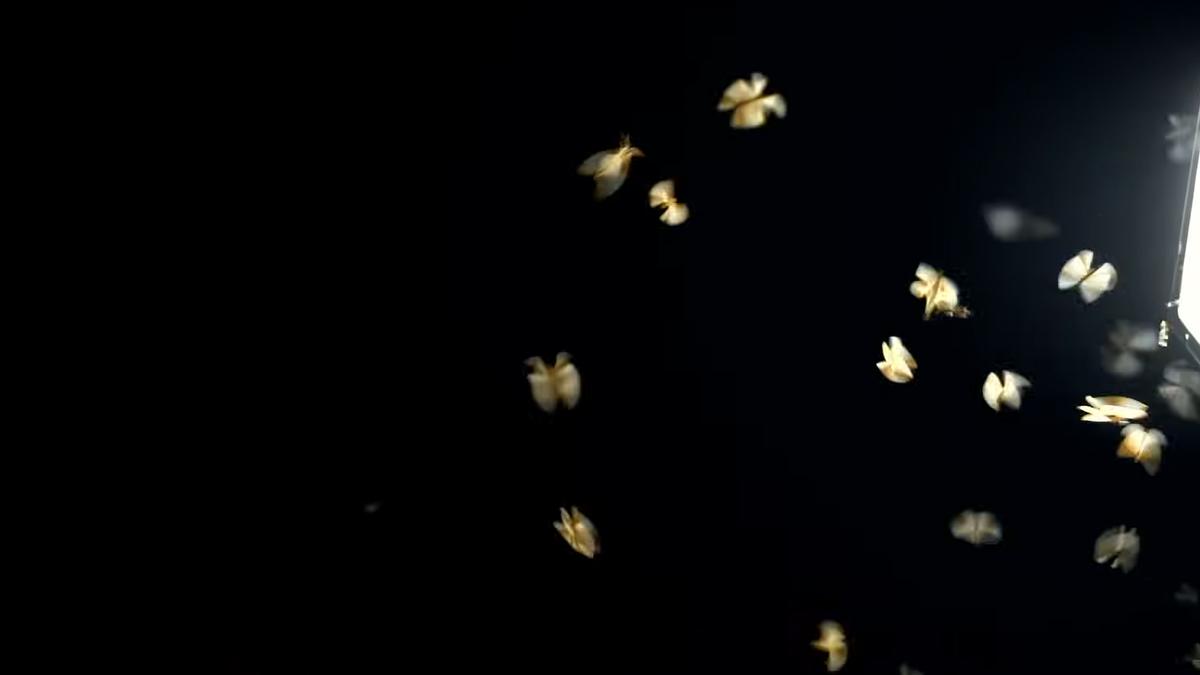
Moths and many other flying insects are commonly drawn to human-made lights at night across the world. Common hypotheses—attraction to heat or misnavigation using the Moon—do not hold up under laboratory tests. New high-speed, night-capable camera technology enables capture of fast-flying insect behavior near lights. Observations indicate a dorsal light response, where insects orient so their upper sides face the brightest nearby area. The dorsal light response can explain circling and hovering behaviors around artificial lights as insects attempt to maintain dorsal orientation relative to a bright source.
"Moths - and many other flying insects - being drawn to human-made light at night is something most people have observed firsthand, across history and around the world. But despite this phenomenon's ubiquity, good explanations for it have proved elusive. As the UK biologist Samuel Fabian details in a short video from Nature, the most common explanations - that the creatures are drawn to heat or that they mistake artificial lights for the Moon while trying to navigate the night sky - don't hold up in lab tests."
"Instead, Fabian argues that new camera technology, finally up to the task of capturing fast-flying insects at night, points to a somewhat novel explanation: what's known as the dorsal light response, in which insects orient themselves so their upper sides face the brightest area around them."
Read at Aeon
Unable to calculate read time
Collection
[
|
...
]