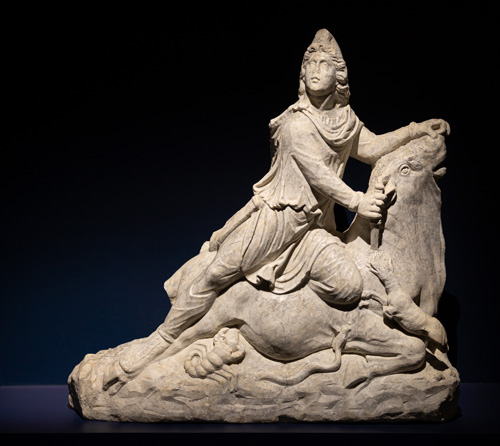
Mithraism emerged in Rome in the first century CE from earlier Persian traditions and adapted new iconography and ideas as it spread west. Mithraic temples commonly depicted Mithras slaughtering a bull, often turning his head away, possibly in pity. The Mithraic mysteries expanded across the Roman Empire and attracted many soldiers who saw Mithras, sometimes linked with Sol Invictus, as protector and symbol of loyalty, courage, and order. Stoicism, founded by Zeno of Citium around 300 BCE, prized wisdom, courage, and self-control. Stoic emphasis on understanding the universe and discerning solvable external problems paralleled Mithraic teachings that encouraged knowledge in spiritual and everyday life.
"Mithraism's adoption and integration of Stoic virtues is compelling and noteworthy. These virtues not only shaped the religious and spiritual dimensions of Mithraism, but also played a pivotal role in the social and cultural fabric of ancient Roman society itself. Mithraism emerged in Rome during the first century CE. It had a complicated history, originating from earlier Persian traditions, but taking on new iconography and ideas as it spread westwards."
"Famously, Mithraic temples usually featured depictions of Mithras slaughtering a bull, often while turning his head away, perhaps in pity. In the Roman world, the Mithraic mysteries began to flourish shortly before the time of Christ's crucifixion, and expanded rapidly across the Empire, though the traditional Roman paganism centred on Jupiter, Mars, Minerva and other gods remained dominant. Roman soldiers in particular, though, were drawn to Mithraism,"
"The philosophical school known as Stoicism had its roots some centuries earlier in Greece, having been founded by Zeno of Citium in about 300 BCE. It eventually become popular among influential Roman writers and thinkers (who loved Greek philosophy). They loved its emphasis on the virtues of wisdom, courage, and self-control. Wisdom, or sophia in Greek, was a cornerstone of Stoic philosophy, particularly the wisdom needed to distinguish those external problems we can solve from those we must simply learn to live with gracefully."
Read at Philosophynow
Unable to calculate read time
Collection
[
|
...
]