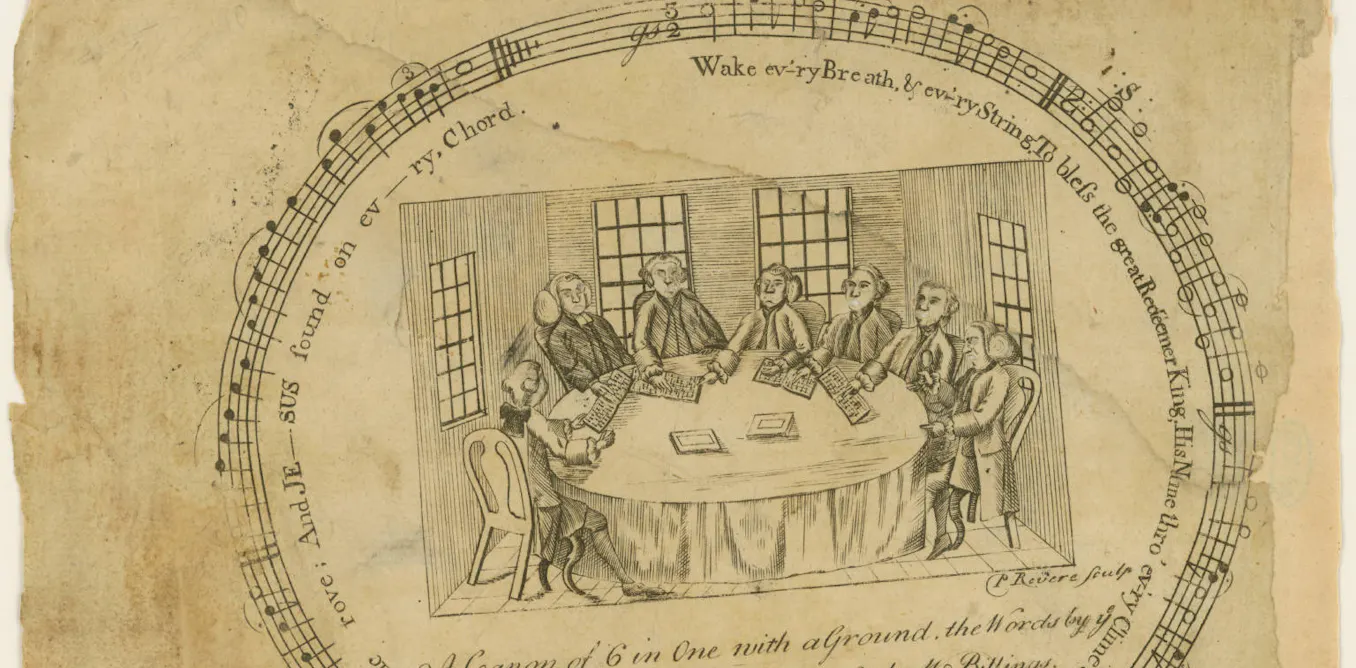
"Billings is widely considered America's first noteworthy composer, publishing six tune books and writing some 340 choral works - some of which are still sung today. Apprenticed at 14 as a leather tanner, he learned music in his spare time and became a renowned teacher of singing schools, which taught basic elements of music so people could sing hymns more confidently. He also became a staunch supporter of independence, one of the Boston "Whigs" who spearheaded the American Revolution."
"One important character who rarely makes it into the limelight is the pioneering composer William Billings, who lived in Boston at the time of the Revolution. Billings is widely considered America's first noteworthy composer, publishing six tune books and writing some 340 choral works - some of which are still sung today."
"Billings was a friend of Samuel Adams, the revolution's great agent provocateur, and sang regularly with him. He likely knew Paul Revere, who is credited with engraving the frontispiece to Billings' first tune book, " The New-England Psalm-Singer," published in 1770."
"As music historian Nathaniel Gould wrote in 1853, Billings was "blind with one eye, one leg shorter than the other, one arm somewhat withered, with a mind as eccentric as his person was deformed.""
William Billings lived in Boston during the American Revolution and is widely considered America’s first noteworthy composer. He published six tune books and wrote about 340 choral works, with some still sung today. Apprenticed at 14 as a leather tanner, he learned music in his spare time and became a renowned teacher of singing schools that taught basic music so people could sing hymns more confidently. He supported independence as a Boston Whig and was connected to revolutionary figures, including Samuel Adams, with whom he sang regularly. He likely knew Paul Revere, who engraved the frontispiece to Billings’ first tune book, The New-England Psalm-Singer, published in 1770.
Read at The Conversation
Unable to calculate read time
Collection
[
|
...
]