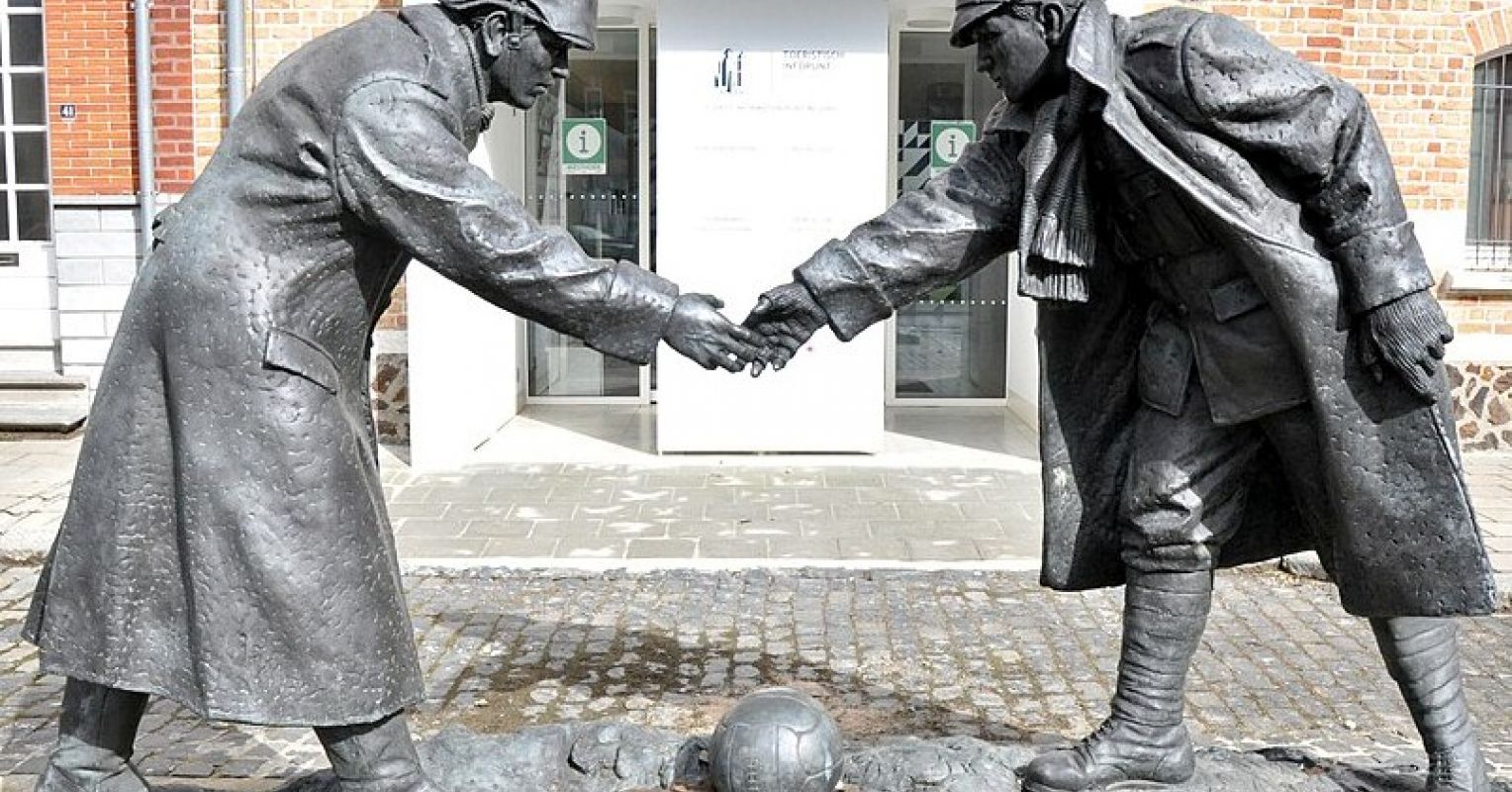
"On December 25, 1914, British and German soldiers stopped fighting and met in the middle of "no man's land" to socialize, exchange gifts, and play soccer. In what has become known as theChristmas Truce of World War I, the men, for a moment, returned to being normal people. Perhaps the holiday made them nostalgic for their families and the joy of the season. From inside the cold, wet, snow-filled trenches, one side started singing Christmas carols, and then the other side joined in."
"The men once again thought for themselves: "Those people on the other side of the battlefield are not our enemies; they are just like us; conscripted slaves forced to kill by their masters." The men remembered their humanity, their individualism, and their critical-thinking ability, and for a few precious hours, they woke up and saw the truth. The next day, however, their officers threatened them with harsh phrases: "You're committing treason; this is blasphemy; and you are fraternizing with the enemy.""
""Despotic governments do not recognize the precious human component of the state, seeing its citizens only as a faceless, mindless-and helpless-mass to be manipulated at will. It is as though people were incidental to a nation rather than its very life-blood." -Aung San Suu Kyi"
Early governments commonly emerged from groups of strongmen who provided protection to settled agricultural communities threatened by marauders. Human beings show a natural tendency to follow leaders, which enables rapid group action but also fosters unthinking conformity. Instances like the 1914 Christmas Truce reveal that individuals can recover empathy and critical judgment, recognizing shared humanity across enemy lines. Military and political overseers often suppress such independent thinking through threats, patriotic rhetoric, and dehumanizing narratives. Questioning assumptions and authorities is essential for creative and critical thought and for resisting manipulative, despotic structures that treat citizens as a faceless mass.
Read at Psychology Today
Unable to calculate read time
Collection
[
|
...
]