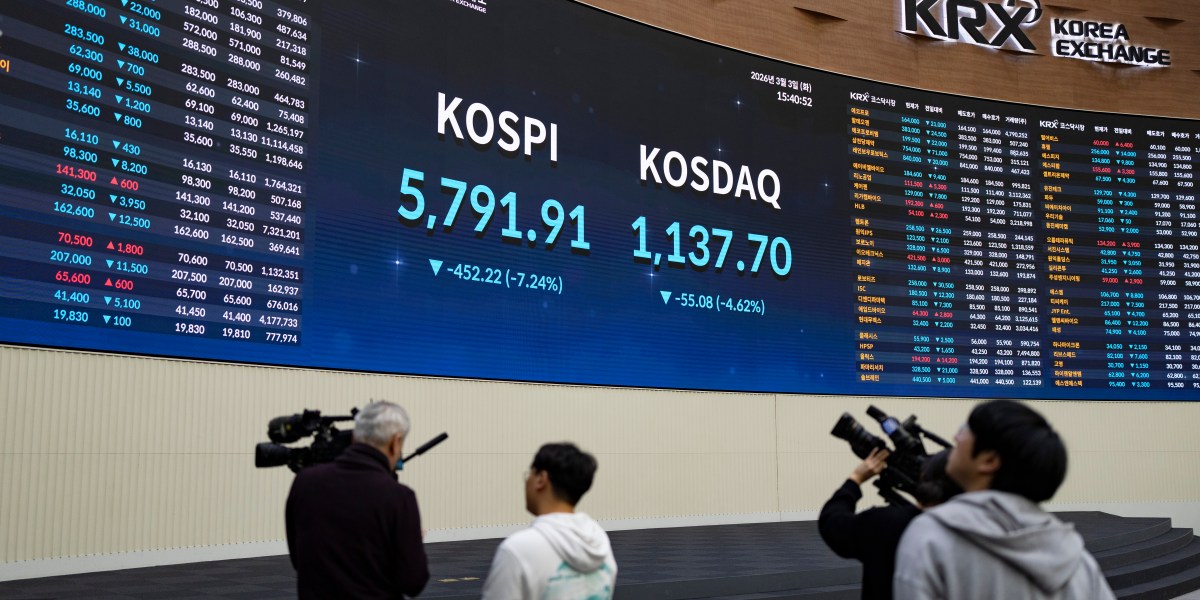
Asian equity markets experienced significant declines following U.S. strikes on Iran, with Japan's Nikkei 225 falling 5.2% and South Korea's KOSPI dropping 6.2% on Monday. The broader decline reflects investor concerns about extended conflict in the Persian Gulf and energy market disruptions. South Korea and Japan, heavily dependent on Middle Eastern oil imports, face particular vulnerability as Iran closed the Strait of Hormuz. Oil prices surged above $115 per barrel. The crisis reversed gains in AI and tech stocks, with Samsung and SK Hynix declining approximately 20% since strikes began. China demonstrated greater resilience, with its CSI 300 index down only 2.3%, attributed to strategic oil reserves and long-term energy planning.
"Market indices plunged on Monday. Japan's Nikkei 225 fell by around 5.2% on Monday, while South Korea's KOSPI sank by 6.2%. Vietnam's VN-Index is down by around 5.7%. Other Asian markets dropped by smaller amounts: Hong Kong's Hang Seng Index fell by around 1.8%, and India's NIFTY 50 is down by 2.5% in morning trading."
"Many Asian economies rely on oil exports from the Gulf, which have slowed to a crawl since Iran closed the Strait of Hormuz last week. South Korea sources about 70% of its crude oil from the Middle East; for Japan, that number is closer to 90%. The price of WTI crude briefly surpassed $115 a barrel on Monday morning."
"The energy shock has reversed a rally in Asia's AI-linked, tech-heavy growth stocks that had soared in the weeks just ahead of the Gulf conflict. South Korean chipmakers Samsung Electronics and SK Hynix both surged on the back of soaring demand for memory chips. Samsung and SK Hynix have now both dropped by around 20% respectively since U.S. strikes began."
"China, by comparison, has proved less volatile than its neighbors, due to its long-term energy planning and massive stockpiles of oil. The CSI 300 index, which tracks stocks traded in Shanghai and Shenzhen, is down by only 2.3% since the war began."
Read at Fortune
Unable to calculate read time
Collection
[
|
...
]