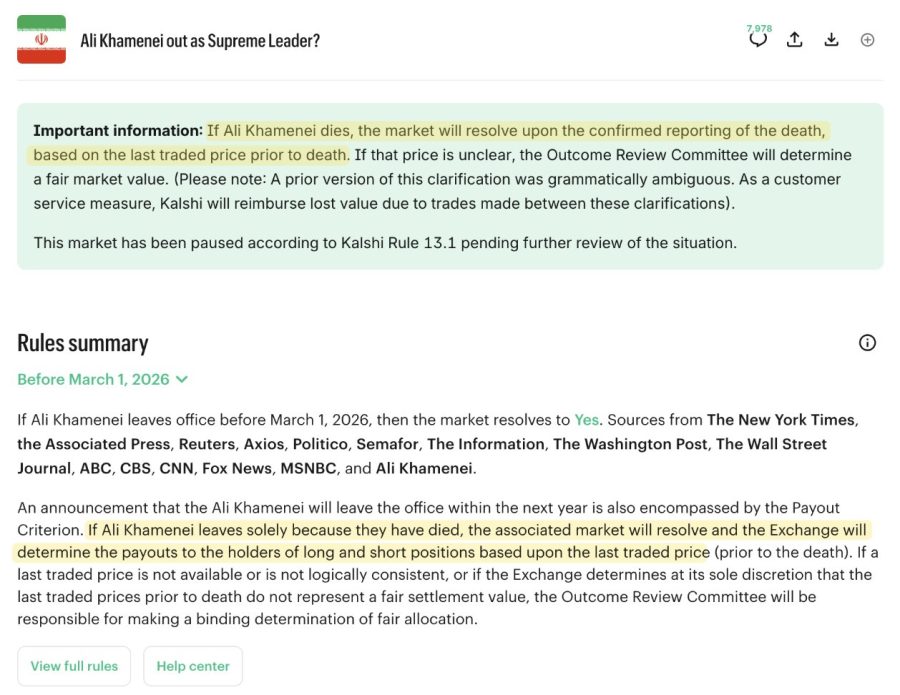
"The Kalshi market in question asked a seemingly straightforward question: would Iran's Supreme Leader, Ali Khamenei, leave office before a certain date? But when news broke that Khamenei had died amid escalating regional conflict, traders quickly discovered that "leave office" did not mean what many assumed it meant. Well, at least not on a CFTC-regulated exchange."
"Kalshi's market rules did, in fact, contain a "death carveout." As the exchange reiterated repeatedly, markets are not supposed to allow users to directly profit from someone's death, which is a restriction tied to Kalshi's status as a federally regulated exchange overseen by the Commodity Futures Trading Commission (CFTC)."
"For a platform that insists its rules were "clear from the outset," Kalshi has spent the last several days explaining itself over and over again, often in slightly different ways, after one of its most controversial markets imploded into confusion, anger, and mass reimbursements."
Kalshi faced significant controversy when its market predicting whether Iran's Supreme Leader Ali Khamenei would leave office before a specified date imploded after his death. Rather than resolving to YES as many traders expected, the market settled at the last traded price before death confirmation, triggering widespread anger and reimbursements. Kalshi defended its decision by citing its rules and a death carveout clause designed to prevent direct profiting from someone's death, a restriction tied to its CFTC regulation. The episode highlighted criticism that Kalshi poorly communicates how its policies affect users. The incident contrasts with unregulated competitors like Polymarket, which operate without such restrictions but face insider trading allegations and regulatory scrutiny.
#prediction-markets #regulatory-compliance #market-settlement-rules #cftc-regulation #trader-disputes
Read at ReadWrite
Unable to calculate read time
Collection
[
|
...
]