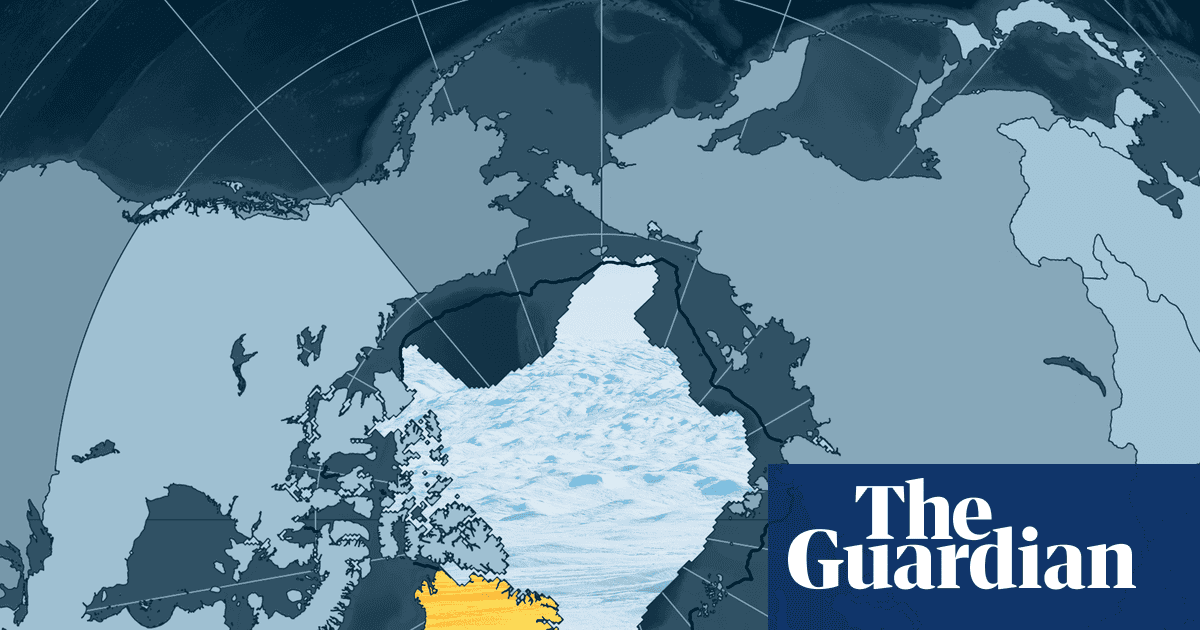
"Lying between the US and Russia, Greenland has become a critical frontline as the Arctic opens up because of global heating. Its importance has been underscored by Donald Trump openly considering the US taking the island from its Nato partner Denmark, either by buying it, or by force. The climate crisis is shrinking Greenland's ice sheet, along with the wider Arctic sea ice, opening new sea routes and exposing valuable resources."
"The average extent of sea ice in the Arctic over the last five years was 4.6m sq km. This is roughly equivalent to the size of the EU. But this is a 27% drop compared with the average of 6.4m sq km between 1981 and 2010, according to data from the National Snow and Ice Data Center. The sea ice lost is roughly equivalent to the size of Libya."
"The Russian nuclear icebreaker Yamal breaking through sea ice in the Arctic. Photograph: Sue Flood/Alamy The most developed is the northern sea route, which overlaps the north-east passage and runs along Russia's Arctic coast from Europe to Asia. It is central to Moscow's ambitions. Further west, the north-west passage cuts through Canada's Arctic archipelago, while a central Arctic route across the north pole is also emerging in long-term planning."
Greenland's strategic value is rising as Arctic warming reduces ice cover, exposing seas, resources, and new maritime corridors. Sea ice extent over the last five years averaged 4.6m sq km, a 27% decline from the 1981–2010 average of 6.4m sq km, roughly the area of Libya. Melting summer ice now leaves seas once inaccessible, enabling commercial navigation beyond icebreakers. The northern sea route along Russia's Arctic coast is the most developed corridor, with the north-west passage and a central Arctic route also emerging. These changes are shifting trade routes and intensifying geopolitical competition.
Read at www.theguardian.com
Unable to calculate read time
Collection
[
|
...
]