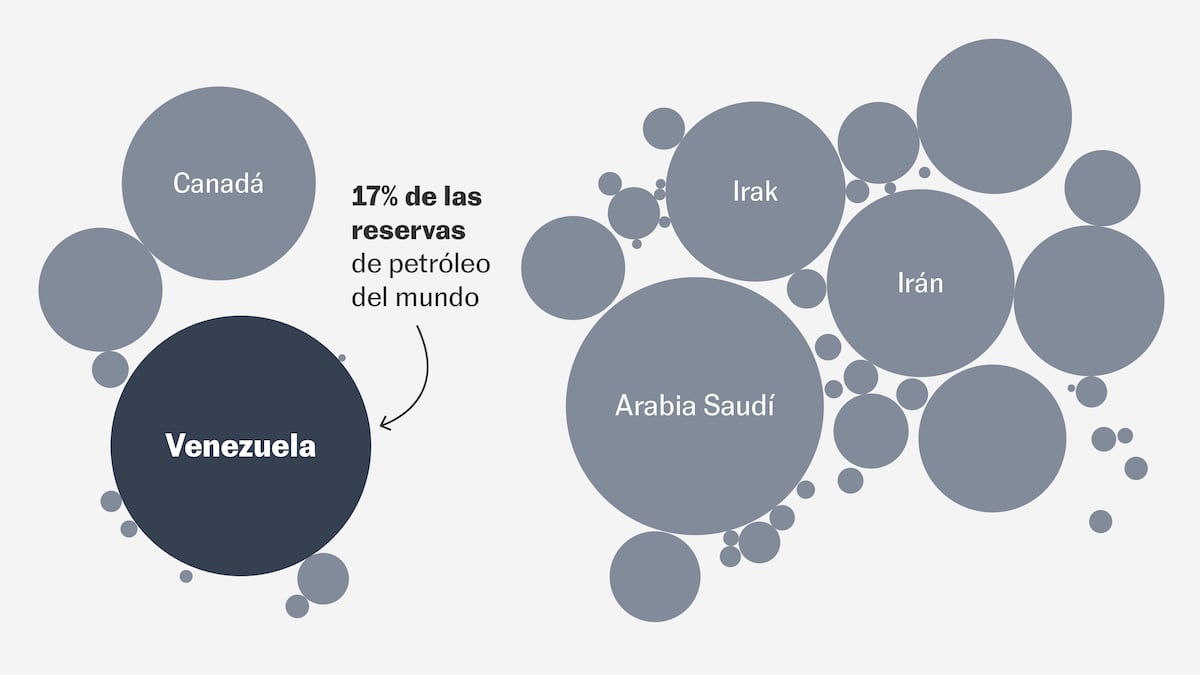
"Venezuela had been found to have considerable deposits which were essential to the country's economy in previous decades but they represented only 3% of the world total. Thirty years later, between 2008 and 2010, Venezuela became the first country to surpass Saudi Arabia in known oil reserves. As announced by the local government and certified by the Organization of the Petroleum Exporting Countries (OPEC), beneath the country's soil lay one of the largest deposits of technically recoverable crude oil in the world."
"The sudden growth of Venezuela's reserves which quadrupled in just five years, reaching 40 billion tons is a unique case. The explanation lies in the Orinoco Belt, a vast area located in the north of the country. Just 20 years ago, when Venezuela was one of the world's leading oil exporters, not a single barrel came from the Orinoco. Today, 80% of its 300 million barrels of production come from that region. But Orinoco crude is unusual: it is heavy and extra-heavy oil."
In 1980 global oil reserves were concentrated in the Middle East, principally Saudi Arabia, while Venezuela accounted for about 3% of the world total. Between 2008 and 2010 Venezuela surpassed Saudi Arabia in known oil reserves after OPEC-certified discoveries increased estimates dramatically. By 2020 Venezuela accounted for roughly 17% of global crude estimates after reserves quadrupled to about 40 billion tons. The Orinoco Belt in northern Venezuela produced almost none of the country's oil two decades earlier but now supplies around 80% of its production. Orinoco crude is heavy and extra-heavy, requiring complex processing, specialized refineries, capital, and technical expertise. PDVSA, state-owned since 1976, has faced dwindling resources, reduced investment, and maintenance shortfalls, especially after 1999 under Hugo Chavez.
Read at english.elpais.com
Unable to calculate read time
Collection
[
|
...
]