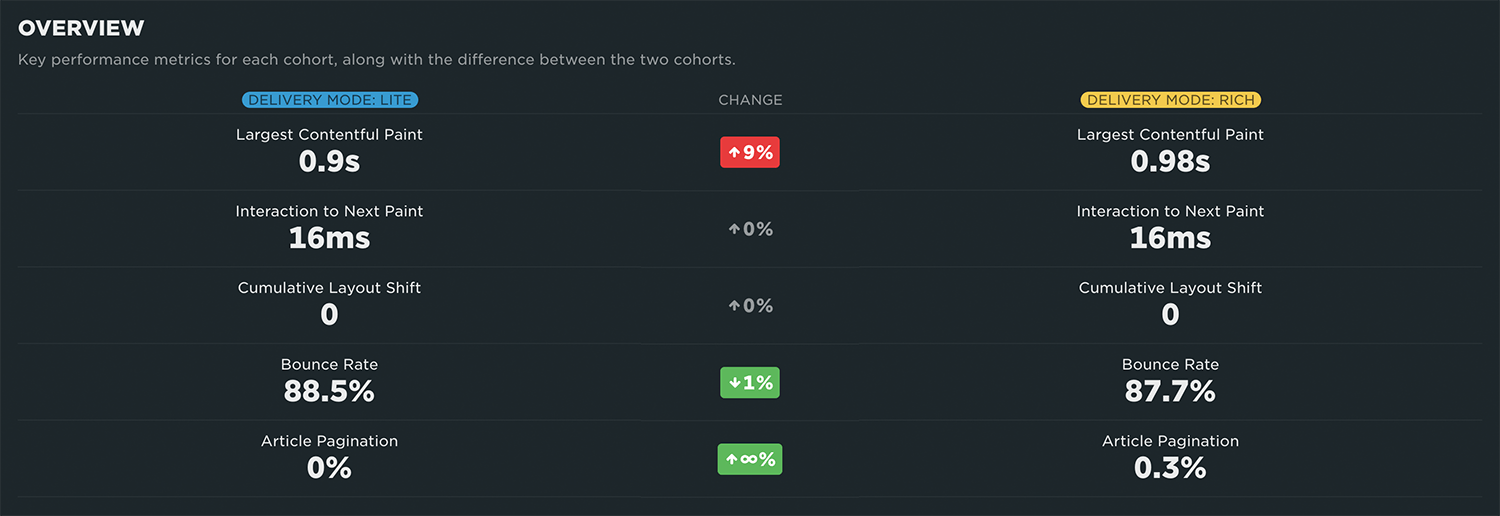
"One thing I encourage all of my clients to remember is that web performance happens somewhere between you and your user. The exact same page on the exact same infrastructure can feel vastly different to two different people, and knowing where the two meet is key to designing truly fast experiences."
"Over the last few years, I've written a fair bit about high latency environments and low- and mid-tier mobile, and one of the recurring themes in both is that site-speed is only partly a property of the site itself. A large part of it is a property of the conditions under which that site is being consumed."
"It's not our fault that someone is on a struggling connection, a weaker device, or a battery that is nearly dead, but it is still our responsibility to design around those scenarios where we can. That, to me, is where Obs.js becomes truly powerful."
"On my homepage, I use Obs.js to alter the masthead imagery depending on the browser's inferred delivery mode. In the faster case, I use the full, high-res image stack: And if Obs.js decides the"
Web performance is determined by factors between the site and the user, so identical pages can feel very different across people and environments. Site speed is only partly controlled by the site itself; consumption conditions such as connection quality, device capability, and battery state strongly affect perceived performance. While these constraints are not caused by developers, responsibility remains to design for them when possible. Context-aware instrumentation can provide useful signals to adapt behavior. Obs.js is presented as a tool that enables such adaptation, including changing imagery based on inferred delivery mode. The goal is to use available context to make experiences feel faster and more appropriate for each user’s situation.
Read at Csswizardry
Unable to calculate read time
Collection
[
|
...
]