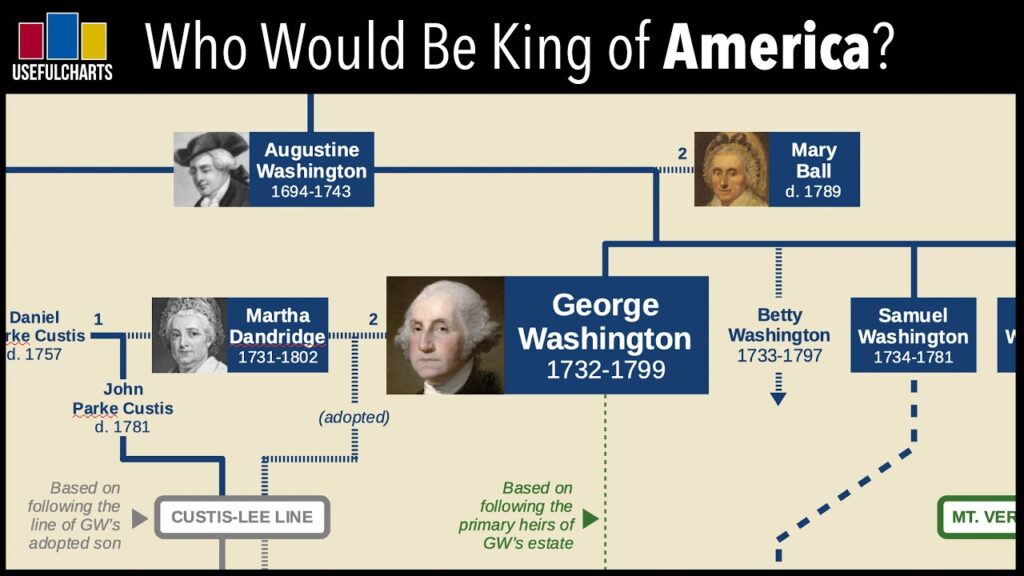
Washington’s refusal to seek a third term established a two-term precedent, but a hypothetical monarchy raises questions about later rulers. A set of succession scenarios considers how American monarchical history might have unfolded if the monarchy had persisted for centuries, assuming other events matched real history. A key complication is that Washington had no biological descendants. Hypothetical royal lineage would therefore be traced through alternative connections, including an adopted son from Martha’s earlier marriage, a nephew chosen as the primary heir of his estate, or the senior-most heir of his father. These branching possibilities determine who might have ruled in later generations.
"One of the first complicating factors is that Washington himself had no biological descendants. Given that, we can trace down a theoretical royal lineage starting with his adopted son, born from his wife Martha's first marriage; with the nephew he selected as the primary heir of his estate; or with the senior-most heir of his father (owner of the notional cherry tree). Not that any of those major paths"
"It was no small thing, for instance, to refuse to seek a third term as the first President of the United States of America - much less to exchange that title for "King of the United States of America." As every enthusiast of American history knows, this set the precedent, only once violated and thereafter written into law, of a two-term limit."
"But as every enthusiast of alternate American history has wondered, what would have happened had Washington become king? And if the U.S. monarchy had remained intact for the past 227 years, who would rule it today? In the UsefulCharts video above, Matt Baker explains a series of different succession scenarios."
#american-history #presidential-term-limits #monarchy-succession #alternate-history #george-washington
Read at Open Culture
Unable to calculate read time
Collection
[
|
...
]