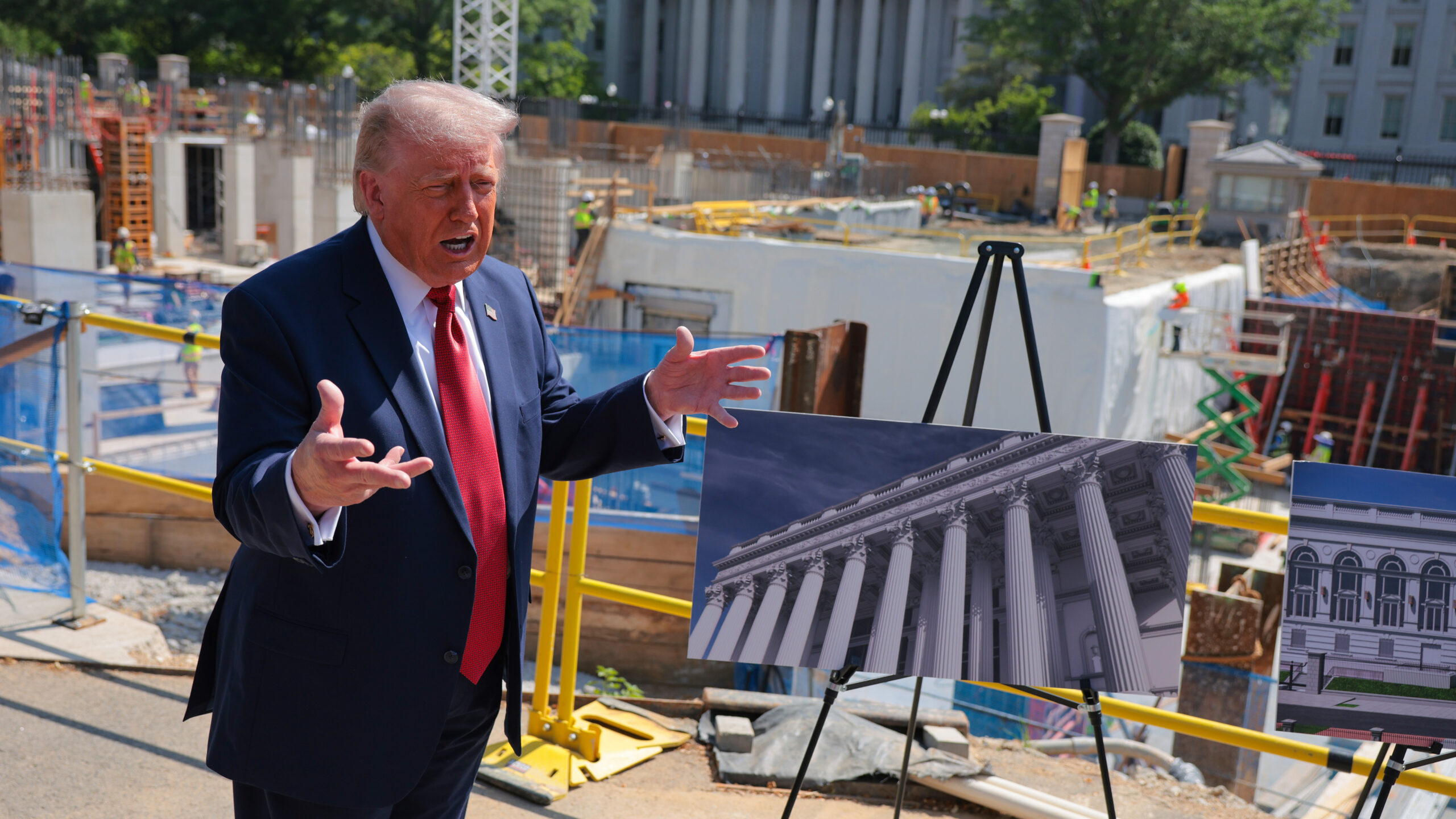
A White House ballroom project includes plans for militarized anti-drone features. The proposal includes a hardened rooftop designed to resist drone strikes and a “drone port” that could house military drones. The president described the rooftop base as capable of supporting “unlimited numbers of drones” operated by the US military to protect Washington. Funding would come from a request for $1 billion in taxpayer money for “security adjustments and upgrades,” separate from $400 million in private donor construction funding. It remains unclear whether the anti-drone measures will be incorporated. The proposal aligns with a Pentagon guide recommending physical hardening measures such as concrete walls, enclosures, and hardened roofs to block drone access to facilities and events.
"The remarks came on May 19 as Trump gave reporters a personal tour of the ballroom project that has already involved the demolition of the White House mansion's East Wing. The president spoke of installing a rooftop drone base "for unlimited numbers of drones" operated by the US military as a "drone port that would protect all of Washington," according to Reuters. He also highlighted a ballroom roof made from "impenetrable steel" that would supposedly be "drone-proof" against potential drone strikes."
"To pay for such measures, Trump has been urging Republican lawmakers in the US Congress to approve $1 billion in taxpayer funding to provide a wide variety of "security adjustments and upgrades" for his ballroom project. The taxpayer-backed security enhancements would be separate from the $400 million construction cost for the ballroom project that has been funded by private donors, including companies such as Amazon, Apple, Coinbase, Comcast, Google, HP Inc., Lockheed Martin, Meta, Micron Technology, Microsoft, Palantir, Ripple, and T-Mobile."
"It's unclear whether the anti-drone security measures and rooftop drone port will actually get incorporated into the ballroom building design. But Trump's comments coincide with the US government's new efforts to protect buildings and crowd events against potential threats posed by drones. In January 2026, the Pentagon issued a "Guide for Physical Protection of Critical Infrastructure" that recommends "hardening" security measures for physically blocking drone access to facilities or events."
"Such physical obstacles could include "concrete walls, enclosures or hardened roofs" designed to protect ag"
Read at Ars Technica
Unable to calculate read time
Collection
[
|
...
]