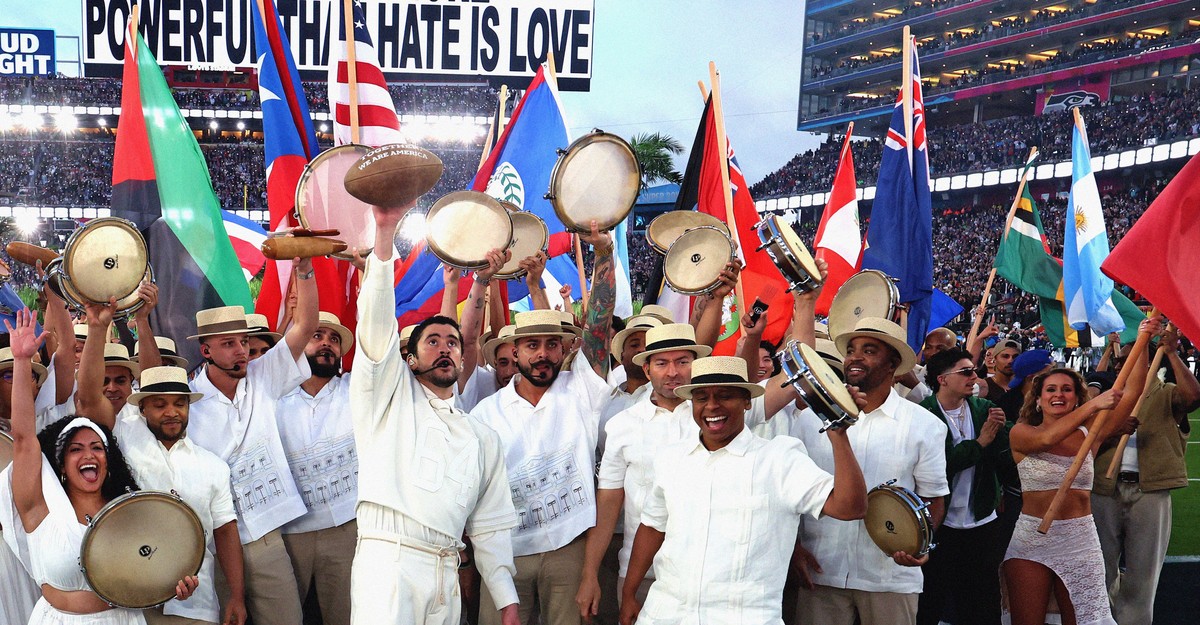
"during Super Bowl halftime, I watched a mustachioed entertainer put on a show that celebrated working-class values, the pleasures of a good party, and the virtues of marriage, with a side serving of grievance against elites. This wasn't Bad Bunny's performance-it was the alternative performance put on by Turning Point USA, led by Kid Rock. Despite the best efforts of the organizers to stoke controversy, I couldn't help but notice how much overlap there was between its message"
"As my colleague Spencer Kornhaber writes, Bad Bunny's show was unifying rather than divisive, but it did have a political message: that working hard, playing hard, and loving America aren't values that belong to any political group or linguistic heritage. Although Turning Point's show was intended to offer a radical contrast, the many thematic convergences only strengthened that argument. Above all, the Turning Point show was boring and dour."
"It kicked off with a distorted-electric-guitar rendition of "The Star-Spangled Banner," a Jimi Hendrix pastiche shorn of all the irony and pathos of the famous version at Woodstock. Brantley Gilbert played "Real American," a bland piece of nu-metal/country patriotic kitsch, and "Dirt Road Anthem," a paean to drunk driving. Gabby Barrett, a former American Idol third-place winner, sang a kiss-off to a cheater and then a love song to "one of the good ones.""
Bad Bunny's Super Bowl halftime performance promoted unity and portrayed working hard, playing hard, and loving America as nonpartisan values. Turning Point USA's alternative show, led by Kid Rock, emphasized similar themes of working-class identity, party pleasures, marriage virtues, and grievance against elites but in a dour, patriotic-rock mode. The Turning Point set included distorted-electric-guitar anthems, nu-metal/country patriotic songs, and sentimental country-pop numbers. Performers delivered kitschy patriotic material and songs that romanticized drinking and rural life. Lee Brice's "Drinking Class" explicitly foregrounded blue-collar pride and the daily grind of manual labor.
Read at The Atlantic
Unable to calculate read time
Collection
[
|
...
]