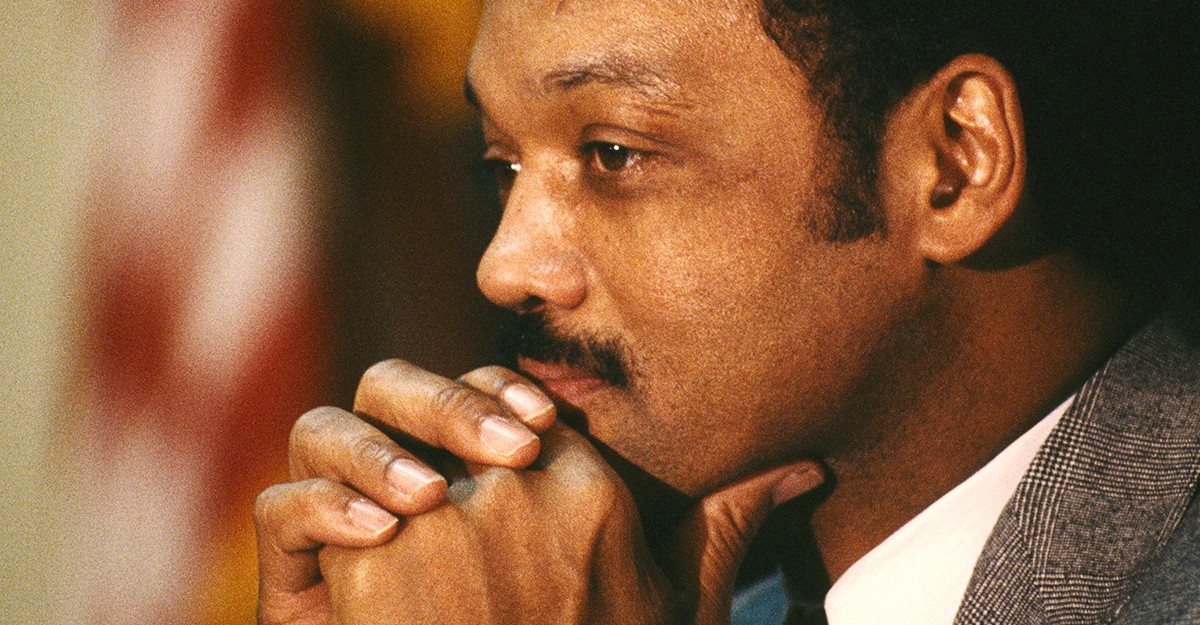
""It changes the way the boy on the street and the boy on Death Row and his mother and his father and his sweetheart and his sister think about themselves. It indicates that one is not entirely at the mercy of the assumptions of this Republic, of what they have said you are, that this is not necessarily who and what you are. And no one will ever forget this moment, no matter what happens now.""
""Have you ever noticed how all composite pictures of wanted criminals resemble Jesse Jackson?""
""There has developed among many, for sure, a kind of attitudinal air-barrier of cynicism""
Many Washington, D.C. businesses displayed signs from Jesse Jackson’s 1984 and 1988 presidential campaigns, reflecting local admiration. James Baldwin called Jackson’s 1984 convention speech transformative for Black self-regard. National television often depicted Jackson as a dangerous, racial demagogue and a comic figure, suggesting that Black progress required morally spotless leaders. Barack Obama’s emergence challenged that assumption, showing that personal propriety did not end critics’ hostility. Right-wing commentators, such as Rush Limbaugh, caricatured Jackson, while Marshall Frady observed a pervasive cynicism around him. The contrast reveals persistent racialized media skepticism toward Black political leadership.
Read at The Atlantic
Unable to calculate read time
Collection
[
|
...
]