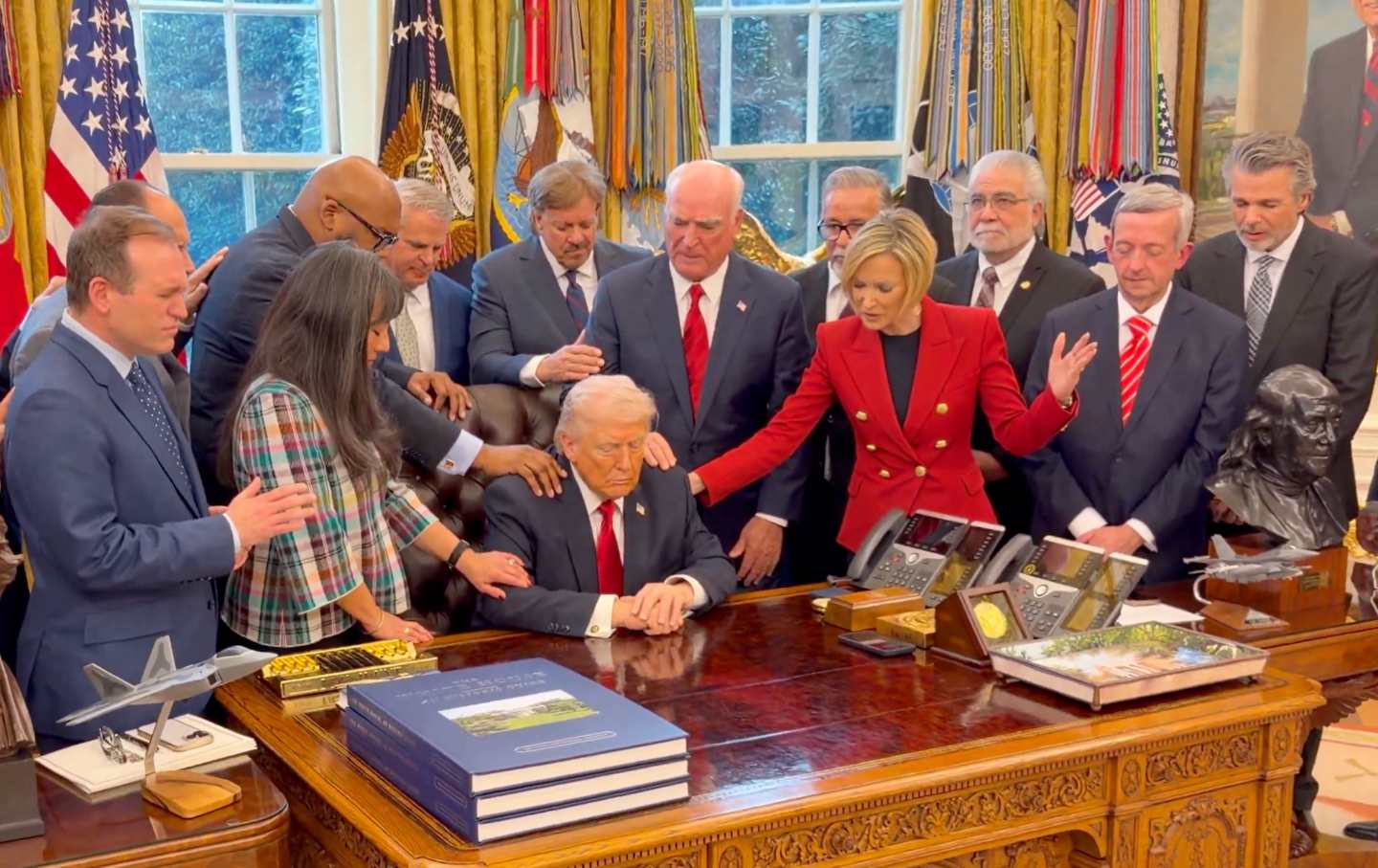
"Donald Trump has often praised William McKinley, a White House predecessor who shared the current president's love of tariffs and territorial expansion. A pious man, McKinley claimed he had divine sanction for the 1898 US annexation of the Philippines in the wake of the Spanish-American War."
"It's impossible to imagine Trump, for all his stated admiration of McKinley, going down on his knees and seeking heavenly council. While Trump is the head of a political coalition whose largest element is evangelical Christians, his own personal faith seems, at best, a cynical and barely disguised performance."
"Since there is no coherent, agreed-upon talking point coming out of the White House, the MAGA movement is free to expl[ore the war in its image]. This puzzling kaleidoscope of excuses has created an opportunity for the religious right to recast the war in its image."
Trump admires McKinley, a president who combined tariffs, territorial expansion, and religious justification for imperialism. McKinley claimed divine sanction for annexing the Philippines, framing it as a civilizing mission. Unlike McKinley, Trump displays minimal personal religiosity despite leading a coalition dominated by evangelical Christians. His 2015 statements revealed skepticism toward religious practice. However, Trump has adopted McKinley's fusion of imperialism and piety through his Iran policy. The White House provided no clear public preparation and offered conflicting justifications including regime change, Israeli pressure, imminent attack fears, nuclear concerns, and negotiation leverage. This absence of coherent messaging allows the religious right to reinterpret the conflict through their own moral framework.
#trump-foreign-policy #religious-justification-for-war #iran-conflict #american-imperialism #political-messaging
Read at The Nation
Unable to calculate read time
Collection
[
|
...
]