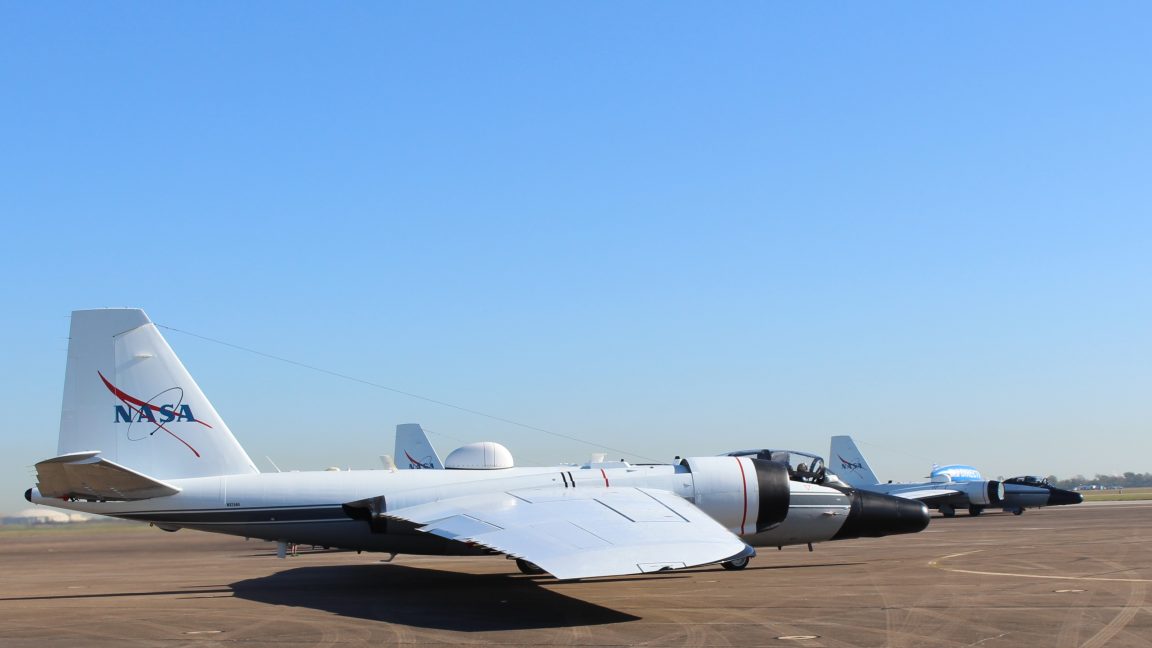
A NASA WB-57 performed a gear-up emergency landing at Ellington Field after touching down without its landing gear extended. The pilot maintained control as the aircraft slid down the runway, slowing through friction, and all crew were unharmed. A mechanical issue caused the gear-up landing; response efforts are ongoing and a thorough investigation will determine the cause and provide updates. The B-57 lineage began in 1944 with development by the English Electric Company; the type later crossed the Atlantic in 1951 and was adopted by the United States Air Force. The WB-57 variant had longer wings, higher altitude capability up to 62,000 feet, and was used for weather reconnaissance and upper-atmosphere sampling for nuclear debris.
"The B-57 line of aircraft dates back to 1944, when the English Electric Company began developing the plane. After the Royal Air Force showcased the B-57 in 1951 by crossing the Atlantic in a record four hours and 40 minutes and becoming the first jet-powered aircraft to span the Atlantic without refueling, the United States Air Force began buying them to replace its aging Douglas B-26 Invader."
"The aircraft performed bombing missions in Vietnam and other military campaigns, and a variant that later became the WB-57 was designed with longer wings that could fly even higher, up to 62,000 feet. This proved useful for weather reconnaissance and, around the world, to sample the upper atmosphere for evidence of nuclear debris where US officials suspected the atmospheric testing of nuclear weapons."
Read at Ars Technica
Unable to calculate read time
Collection
[
|
...
]