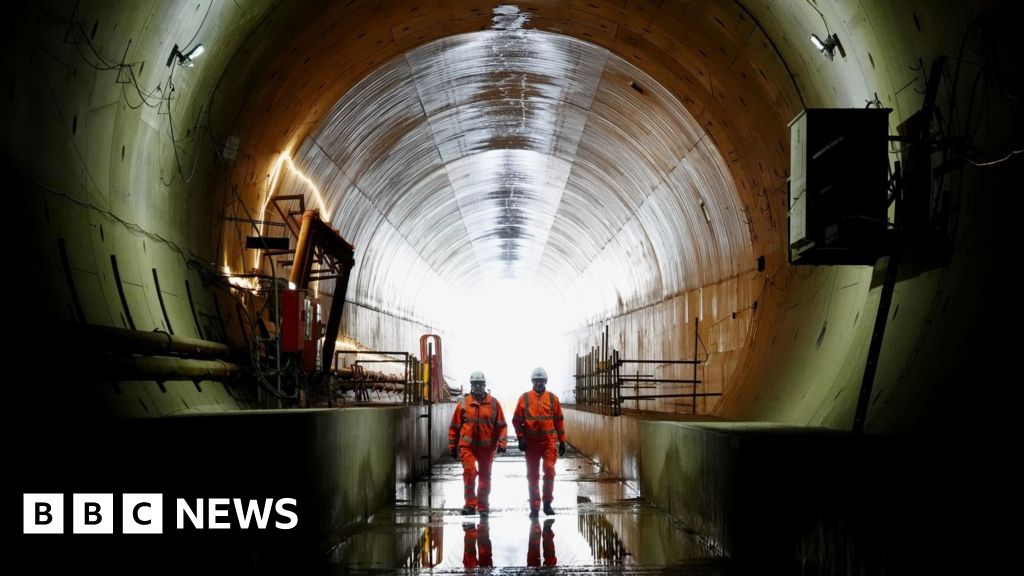
"Construction has finished on HS2's longest tunnel, which includes extensions with ventilation holes carved out to prevent sonic booms. Trains travelling at 200mph (322km/h)will take only three minutes to go through the 10-mile (16km) Chiltern tunnel, which runs under the Chiltern Hills in Buckinghamshire. HS2 Ltd's head of civil engineering for the project, Mark Clapp, paid tribute to "everyone involved" and claimed their "hard work" would "stand the test of time"."
"The HS2 project aims to link London with Birmingham by high-speed rail, with a completion date yet to be finalised. PA Media In 1974, tests on Japan's Shinkansen revealed that highspeed trains could produce sonic booms, caused when trains force air forwards through a tunnel which creates loud bangs at the other end. Their bullet trains were given long noses to reduce the pressure building, but that solution was not suitable for HS2 as trains would also operate on lines designed for traditional stock."
"The Chiltern tunnel was therefore built with 220m (722ft) long extensions, perforated with ventilation holes, to stop booms occurring. Work to carve out the tunnel started when two boring machines were turned on in May and June 2021. They finished their work in February and March 2024, at which point five ventilation and access shafts were sunk, reaching depths of up to 255.9ft (78m)."
"There are 40 passages that link the two tunnels, allowing passengers to walk between them in an emergency. Tracks and overhead electrical equipment will be installed as part of later phases of the project. PA Media HS2 Ltd warned that although "clear progress" was being made on the 140-mile (230km) route between England's two biggest cities, there was "still significant work to do"."
Construction on the 10-mile (16km) Chiltern tunnel has finished, allowing trains travelling at 200mph (322km/h) to pass through in about three minutes. The tunnel includes 220m (722ft) long extensions perforated with ventilation holes to prevent sonic booms that can occur when high-speed trains force air through tunnels. Two tunnel boring machines began work in May and June 2021 and completed tunnelling in February and March 2024. Five ventilation and access shafts were sunk to depths up to 255.9ft (78m). Forty passages connect the two bores for emergency egress. Tracks and overhead electrification will be installed in later phases. HS2 Ltd says clear progress has been made but significant work remains and a new cost and timetable is due later this year.
Read at www.bbc.com
Unable to calculate read time
Collection
[
|
...
]