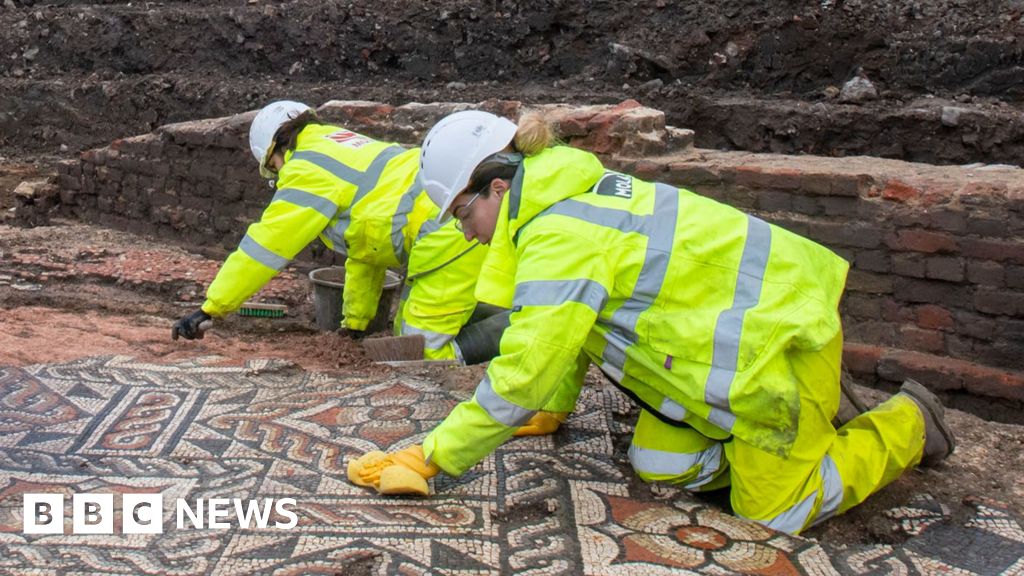
"The constant churn of a changing London means new finds are regularly being made across the city as blocks and buildings make way for new developments, providing archaeologists with a brief glimpse into the earth below. Recent years have seen everything from what is believed to be London's earliest theatre and the city's first basilica being discovered, while a dig in 2021 near the Shard revealed a rare mausoleum and a luxurious Roman villa."
"It is this, and in particular 20 colourful frescoes found smashed into 10,000 pieces in a Roman pit, which features in a new series of the BBC Two show Digging for Britain. "We're seeing these new discoveries as they emerge out of the ground," says Roberts, who fronts the programme. "We seem to have some quite rare pigments [on the frescoes] and there is a unique feature on one of the pieces, which is a signature, we think, of the artist who actually painted the fresco, so those details are always beautiful and extraordinary"."
"Sophie Jackson, the group's director of development, says they always knew the work would be taking place between two Roman roads that once had buildings along them, but the pit and wall plaster came as a surprise to everyone. "Working in London is just fantastic," she explains. "I wasn't going to be an archaeologist, I didn't even have an archaeology degree... but it becomes very addictive because the sites are so brilliant.""
London contains deeply layered archaeological deposits spanning prehistory through Victorian and Edwardian eras, producing frequent discoveries during redevelopment. Finds in recent years include what is believed to be the city's earliest theatre, its first basilica, a rare mausoleum and a luxurious Roman villa uncovered near the Shard in 2021. Twenty colourful frescoes were recovered shattered into around 10,000 fragments, exhibiting rare pigments and a possible artist's signature. A Museum of London Archaeology excavation between two Roman roads unexpectedly exposed a pit and wall plaster. Urban excavations are distinguished by centuries of deposits stacked one atop another.
Read at www.bbc.com
Unable to calculate read time
Collection
[
|
...
]