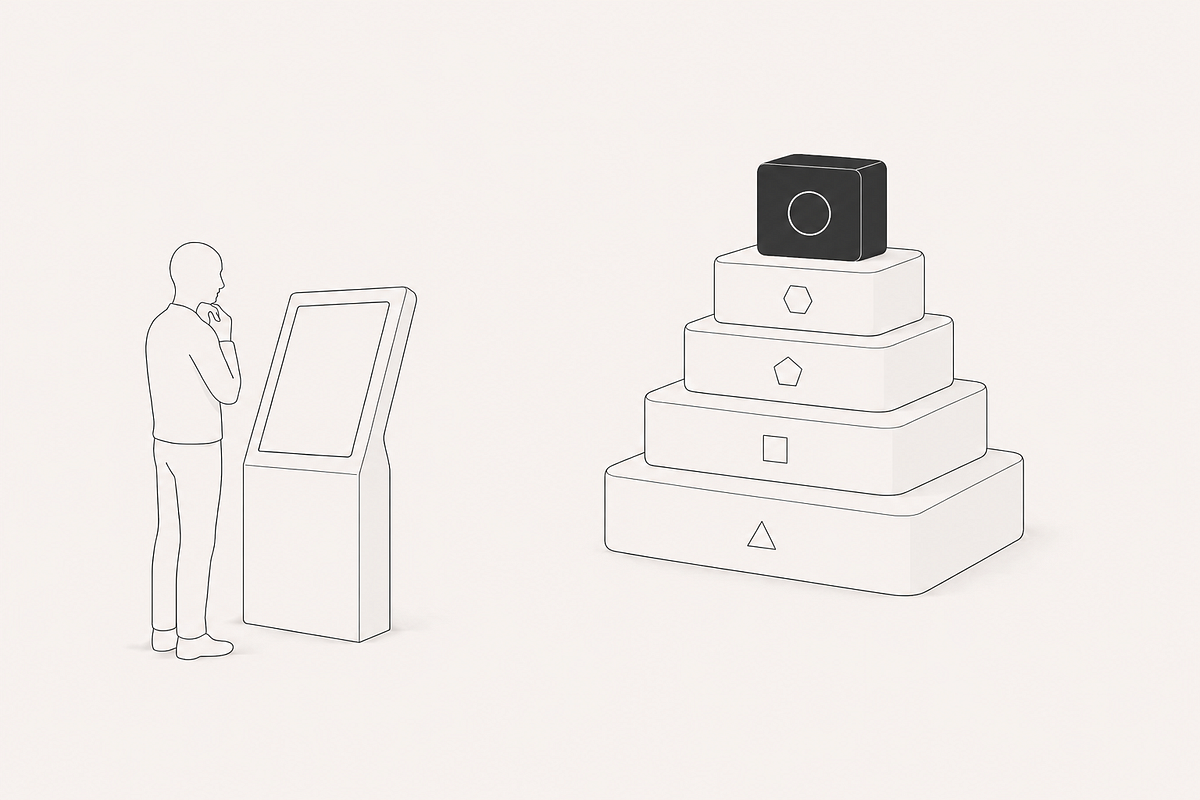
"I was interested in how a logo could evolve without becoming unrecognisable. How an identity could move through time while carrying something forward: a shape, a colour, a memory. I spent months looking at marks that survived because they did not stay completely fixed. Alfa Romeo, Fiat, Renault. Identities that moved by keeping something still. Some changed almost imperceptibly and some changed radically and then had to find their way back. Others carried one element forward so stubbornly that everything else around it could move."
"The question was not how to avoid change. The question was how to remain legible through it. Apparently I'm continuing my nostalgic streak. My previous piece started with an old image I made in 2008; this one has sent me back to my thesis. Maybe I have been circling the same problems for too long. That feels much closer to the Claude problem than I first wanted to admit."
"The fear is not that influence entered the work. Influence was already there. The fear is that, after passing through the machine, the idea might stop being recognisably mine. That's the part that makes the word "mine" wobble. Maybe "mine" is not the absence of outside influence. Maybe it is the continuity of selection: the pattern of what I keep choosing, rejecting, returning to, simplifying, defending."
"Maybe authorship is not the fantasy of being untouched. Maybe it is the recognisable behaviour of a mind changing over time. The Claude conversation is the same activity, sped up and made legible. Iteration twenty is the output of the same kind of loop that produced everything I've ever made: a loop between me and stuff that is not me, except now there is a chat history. Now I can scroll back and see the suggestion I rejected, the phrasing I hated, the structure I a"
A design thesis in 2014 focused on evolving logos without losing recognizability. The work examined how brand identities can move through time while carrying forward shapes, colors, and memories. Examples included Alfa Romeo, Fiat, and Renault, showing changes that were subtle, radical, or centered on stubbornly retained elements. The central question was not how to avoid change, but how to remain legible through it. Authorship was reframed as continuity of selection, meaning repeated choices to keep, reject, return to, simplify, and defend certain patterns. Influence was treated as unavoidable, while the key concern became whether the idea remains recognizably one’s own after external processing. Iteration and chat history were described as a sped-up, visible loop between a mind and external material.
Read at Medium
Unable to calculate read time
Collection
[
|
...
]