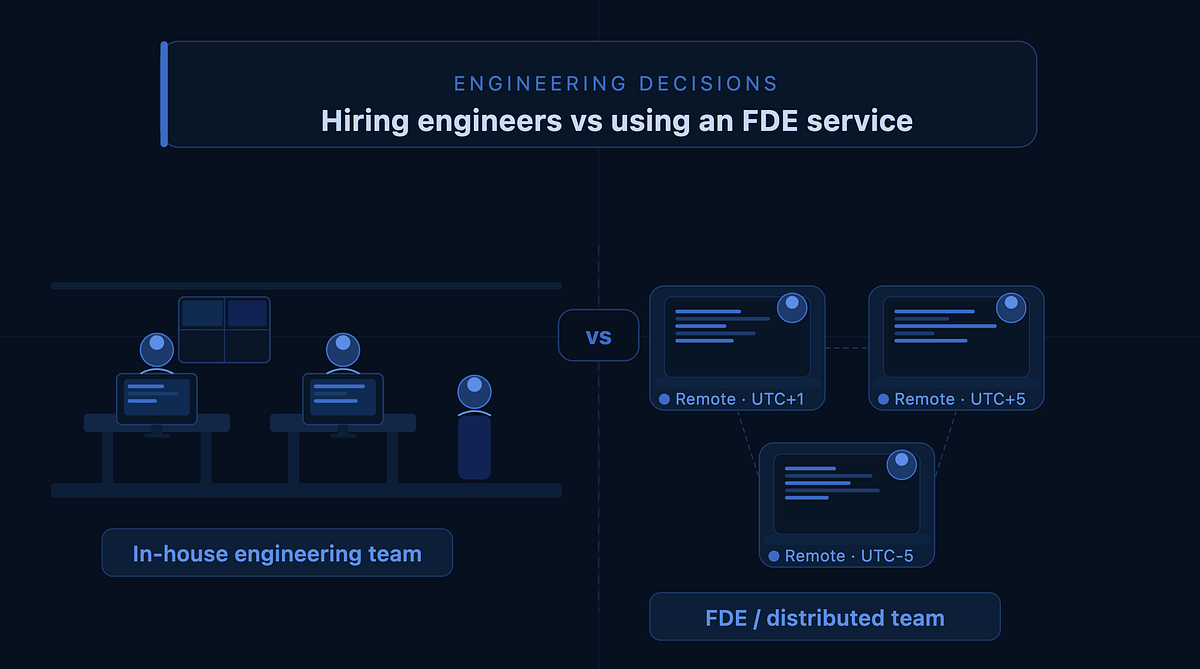
Hiring full-time software engineers provides dedicated ownership, deeper institutional knowledge, and long-term product alignment. Internal teams can evolve with architecture, shape engineering culture, and become a competitive advantage, but they require recruiting cycles, onboarding time, fixed payroll costs, and capacity planning that can lead to underutilization or overstretch. Fully loaded senior engineers in the U.S. can cost 40–70% more than base salary, often exceeding $250,000 annually, and hiring can take 3–6 months, reducing productivity while roles remain unfilled. Fractional Development Engineering (FDE) provides senior expertise on demand for targeted milestones, architectural shifts, scaling challenges, or time-sensitive launches without expanding headcount. The choice depends on product stage, roadmap volatility, and tolerance for operational overhead.
"Hiring full-time software engineers has long been the default path. It gives you dedicated ownership, deeper institutional knowledge and long-term product alignment. Over time, an internal team can evolve with the architecture, shape engineering culture and become a core competitive advantage. But that model also comes with significant commitments: recruiting cycles, onboarding time, fixed payroll costs and the reality that capacity is either underutilized or overstretched depending on the quarter."
"In the U.S. today, a fully loaded senior software engineer after salary can cost a company 40-70 percent more than the base salary alone, often exceeding $250,000 / year for experienced roles. This includes extended hiring cycles (often 3-6 months), where companies lose productivity and opportunity while a role remains unfilled."
"An FDE (Fractional Development Engineering) service introduces a different operating model. Instead of building permanent capacity, you access senior-level engineering expertise on demand. The focus is on targeted execution, faster ramp-up and flexibility. You engage specialized talent for specific product milestones, architectural shifts, scaling challenges, or time-sensitive launches without expanding headcount."
"At a high level, this comparison is not simply hiring versus outsourcing. It is a structural decision about how you allocate engineering capacity, manage risk and maintain velocity. One approach builds long-term internal muscle. The other optimizes for capital efficiency and precision deployment. The right choice depends less on ideology and more on your product stage, roadmap volatility and appetite for operational overhead."
#software-engineering #hiring-strategy #fractional-services #engineering-capacity-planning #cost-optimization
Read at Medium
Unable to calculate read time
Collection
[
|
...
]