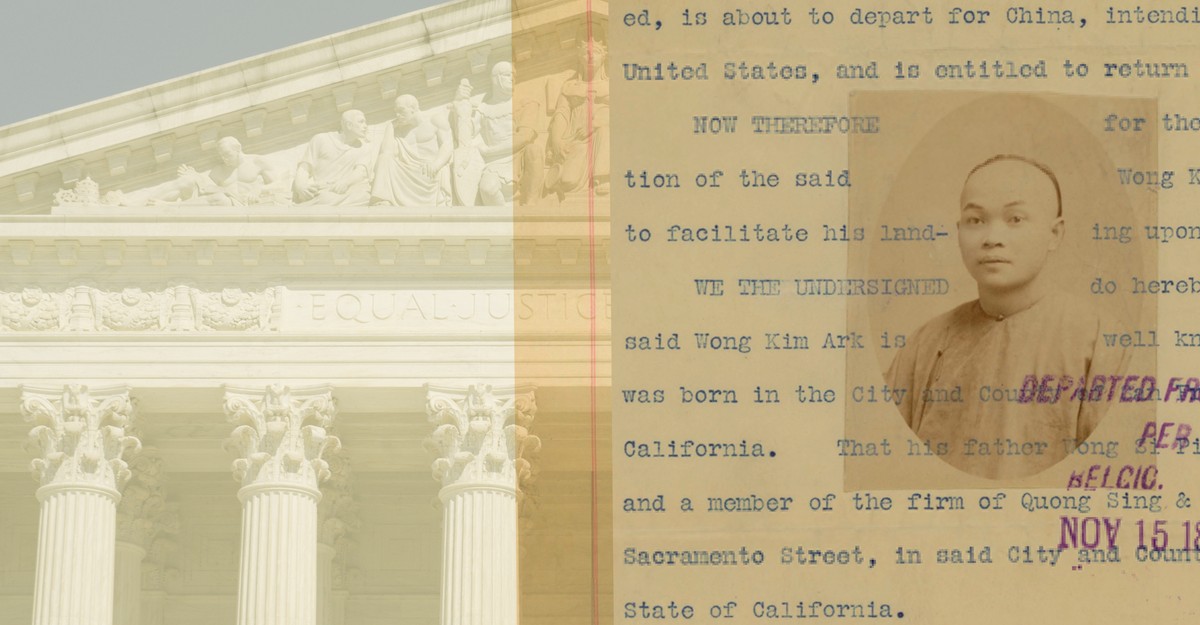
"The Supreme Court first dissected the citizenship clause of the Fourteenth Amendment, which recognizes the citizenship of all persons 'born or naturalized in the United States, and subject to the jurisdiction thereof,' in the 1898 case of United States v. Wong Kim Ark."
"Relying on centuries of English law that influenced the U.S. Constitution, the Court explained that so long as someone is domiciled on American soil—even if they are a citizen or subject of another country, and even if their allegiance to America is fleeting—then such persons are 'within the allegiance and the protection, and consequently subject to the jurisdiction, of the United States.'"
"The administration's arguments are much the same as those made by the Native Sons during World War II, as is the damage that accepting them would inflict."
The Supreme Court's recognition of birthright citizenship in 1898 has been a cornerstone of American law. Recent challenges to this principle, notably from the current presidential administration, mirror past attempts by groups like the Native Sons of the Golden West during World War II. The Fourteenth Amendment's citizenship clause, affirmed in United States v. Wong Kim Ark, states that all persons born in the U.S. are citizens, regardless of their parents' citizenship status. This principle is now under scrutiny once again as the Court prepares to hear arguments in Trump v. Barbara.
#birthright-citizenship #supreme-court #fourteenth-amendment #trump-v-barbara #historical-challenges
Read at The Atlantic
Unable to calculate read time
Collection
[
|
...
]