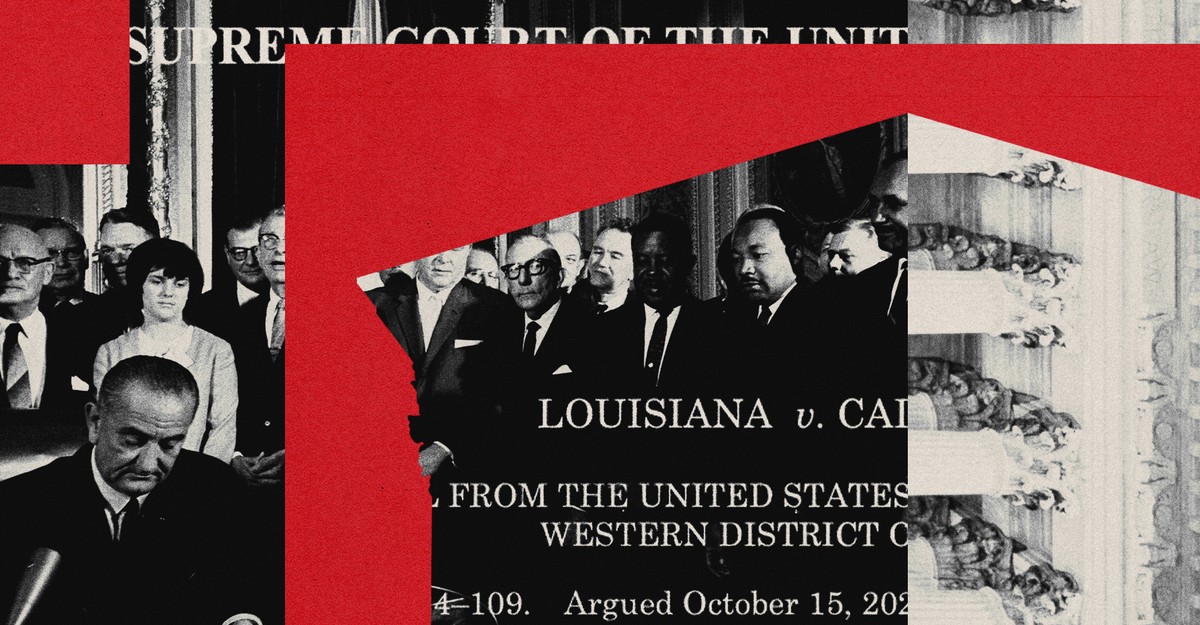
"The Supreme Court's conservative majority completed its 13-year campaign against the law. In Louisiana v. Callais, the Court limited the use of race in drawing congressional reapportionment plans and the ability of minority groups to challenge potentially discriminatory maps."
"Justice Samuel Alito declared that the only permissible consideration of race in creating new districts is when 'present-day intentional racial discrimination regarding voting' can be proved, rejecting any practical attempt to remedy past and present racism in redistricting plans."
"In the South, voting is intensely polarized along racial lines: White voters generally support the opponents of whomever Black voters support. Gerrymanders that discriminate against Black voters could be justified today as merely offering partisan advantage to Republicans."
"The VRA and subsequent case law acknowledged this problem, and recognized that the only practical remedies would have to factor in race."
The Voting Rights Act of 1965 was crucial in ensuring Black suffrage and equal ballot access. However, the Supreme Court's recent ruling in Louisiana v. Callais restricts the use of race in congressional reapportionment, undermining efforts to address racial discrimination in voting. Justice Alito's majority opinion requires proof of intentional racial discrimination, disregarding historical and systemic racism. This ruling allows for potential gerrymandering that could disadvantage Black voters, highlighting the ongoing challenges to voting rights in the South.
Read at The Atlantic
Unable to calculate read time
Collection
[
|
...
]