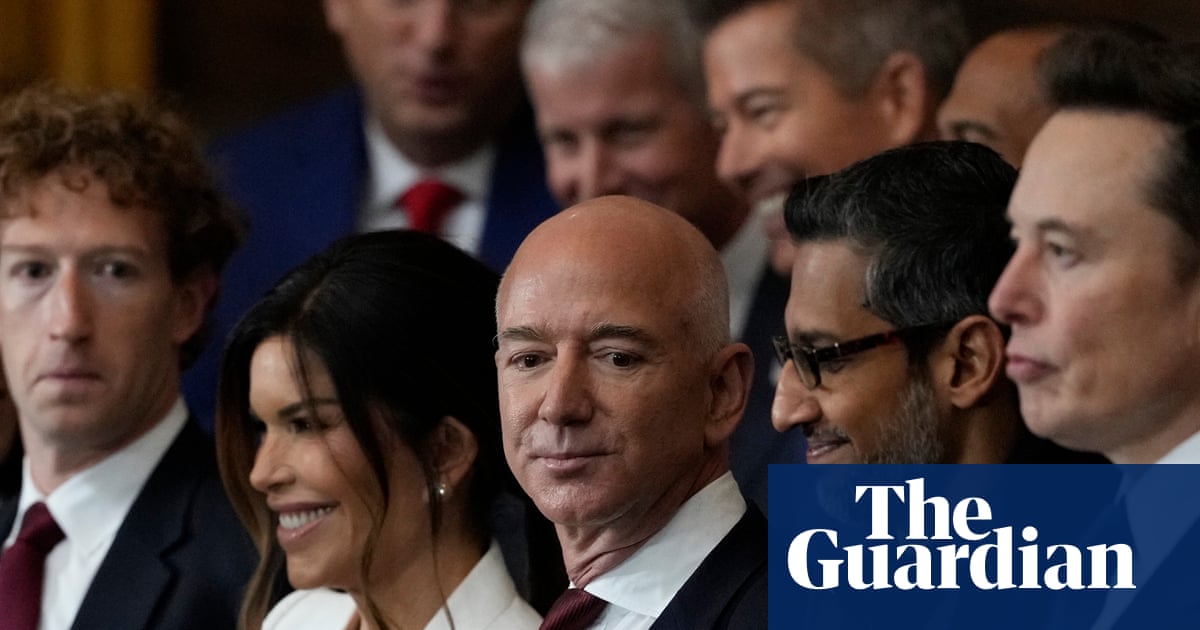
"The oligarchy has changed drastically since then. Bernard Arnault, of French luxury group LVMH, Amancio Ortega, the Spanish clothing mogul, and Warren Buffett, the US investor, were the only old-school billionaires among the top 10 in 2025. The rest largely made their money from high-tech: Elon Musk, Jeff Bezos, Mark Zuckerberg, Larry Ellison, Steve Ballmer and Google's Sergey Brin and Larry Page."
"This evolution offers a startling reminder of how fast new technologies have revolutionized the world economy over the last quarter-century, and how narrowly this brave new world is sharing the fruits of its prosperity. It raises a critical question: what happens when a narrow clutch of oligarchs at the helm of the technological revolution, sitting at the apex of wealth and power, get to determine the direction of humanity?"
"These are consequential questions. It appears they will not be decided through public deliberation. Is human- or even superhuman-level artificial general intelligence a goal we should strive for? Do we know what that means? How many trillions of dollars and terawatts of energy should we deploy to get there? What business models will survive it? Will it wipe out human labor?"
In 1992, Bill Gates joined Forbes's top 10 billionaires alongside a diverse group from various industries and countries, with combined fortunes totaling roughly $100 billion (0.4% of US GDP). By 2025, the billionaire landscape transformed dramatically, with tech entrepreneurs dominating the top 10. Only three old-school billionaires remain: Bernard Arnault, Amancio Ortega, and Warren Buffett. The rest—Elon Musk, Jeff Bezos, Mark Zuckerberg, Larry Ellison, Steve Ballmer, Sergey Brin, and Larry Page—built fortunes through high-tech ventures. Their combined wealth reached $16 trillion, representing 8% of US GDP. This concentration reflects how rapidly new technologies revolutionized the global economy while concentrating prosperity among a narrow elite. Critical questions about artificial general intelligence, energy deployment, labor displacement, and wealth redistribution remain unanswered and appear unlikely to be decided through public deliberation.
#tech-billionaires #wealth-concentration #artificial-intelligence #economic-inequality #technological-power
Read at www.theguardian.com
Unable to calculate read time
Collection
[
|
...
]