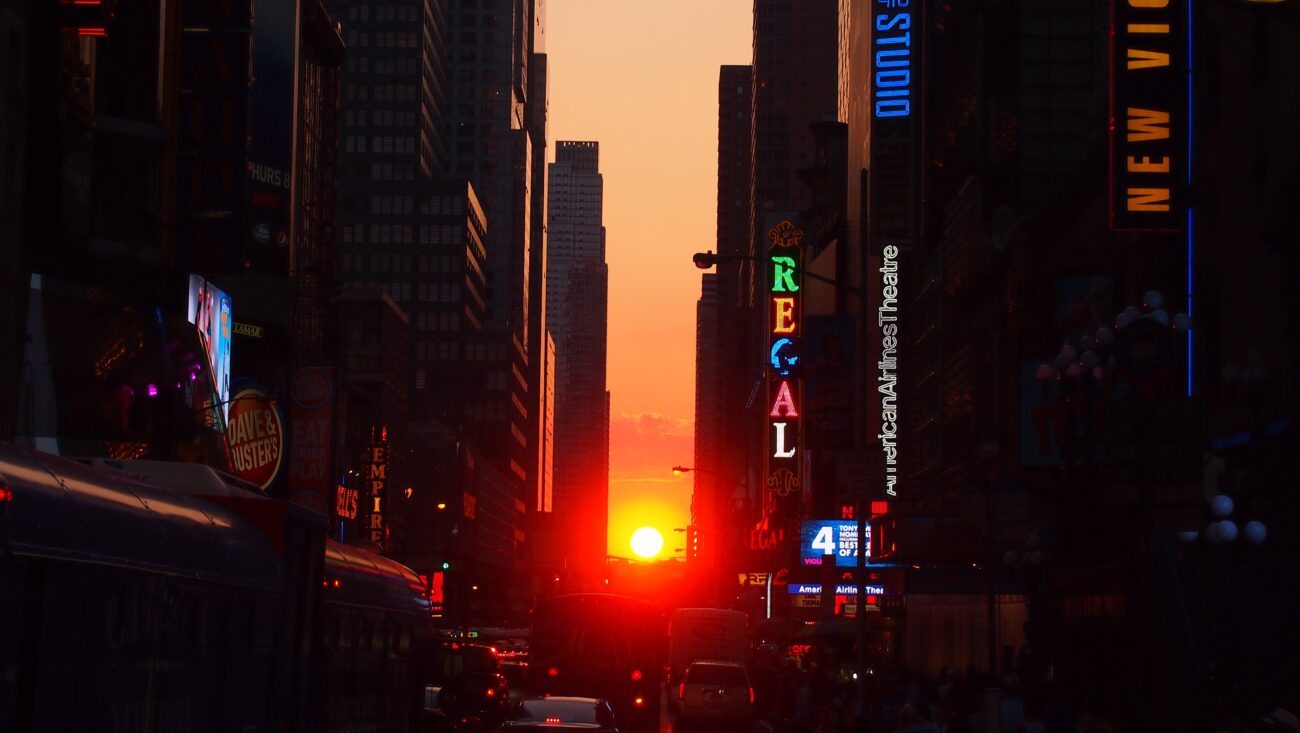
Crowds gather in Midtown just before sunset on May 29 to watch the sun align between Manhattan’s buildings during Manhattanhenge. The event lasts only a few minutes but creates a striking golden view as the sun appears at the end of 42nd Street. Manhattanhenge is a predictable alignment caused by the city’s east-west grid and the times of year when the sun’s apparent position matches the streets. While many treat it as a photo opportunity, it can spark curiosity and shared wonder. Awareness of the sun’s seasonal path supports spatial memory and pro-environmental behavior. Modern life often outsources this knowledge to devices, weakening understanding of where seasonal markers come from.
"“Our east-west grid, which isn't perfectly east-west, is such that there are times of the year where the sun appears to be exactly aligned with the streets.” This alignment creates a striking visual: the sun appears to sit at the end of 42 nd Street as the buildings that frame it glow, radiating a golden light."
"“Our east-west grid, which isn't perfectly east-west, is such that there are times of the year where the sun appears to be exactly aligned with the streets.” This alignment creates a striking visual: the sun appears to sit at the end of 42 nd Street as the buildings that frame it glow, radiating a golden light."
"In a city where most people only notice the sky in relation to buildings, astronomical events can “spark curiosity, and a sense of shared wonder.” This attention, while fleeting, is essential. It's a reminder that we live on a tilted, rotating planet orbiting something much larger-a perspective scientists increasingly see as essential to spatial memory and pro-environmental behavior."
"“There's nothing wrong with technology per se,” he says, “but it's removed the sense of where these significant seasonal markers and dates come from.” The result is a growing disconnection, not just from the sky, but from how"
Read at State of the Planet
Unable to calculate read time
Collection
[
|
...
]