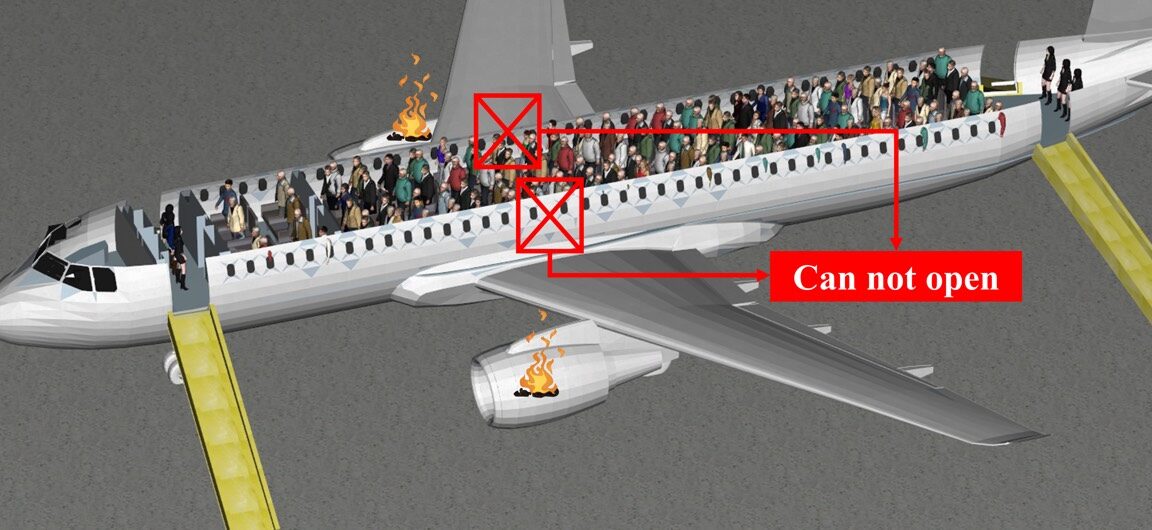
"While a dual-engine fire scenario is statistically rare, it falls under the broader category of dual-engine failures and critical emergencies in aviation. History has shown that dual-engine failures and emergencies, such as the famous 'Miracle on the Hudson' involving Captain Sullenberger, can happen and lead to severe consequences."
"Zhang et al. created two passenger categories: elderly adults age 60 and older and those younger than 60 years. They modeled three different ratios of those two categories to capture more realistic travel dynamics and exclude edge cases."
"None of the tested conditions resulted in evacuation times within the FAA-mandated 90 seconds. The shortest evacuation time was 141 seconds, while the longest was 218.5 seconds."
"Zhang et al. acknowledge that their study has some limitations. For instance, not all elderly passengers are the same, and their models did not incorporate the need for crew assistance for decreased mobility."
Dual-engine fire scenarios are categorized as low-probability but high-impact events in aviation. A study modeled evacuation dynamics for elderly and younger passengers under various seating arrangements. None of the scenarios achieved the FAA-mandated evacuation time of 90 seconds, with the shortest time being 141 seconds. Limitations include the lack of consideration for varying mobility among elderly passengers and the focus on a specific emergency type. Future simulations could enhance accuracy by incorporating empirical data and broader evacuation scenarios.
Read at Ars Technica
Unable to calculate read time
Collection
[
|
...
]