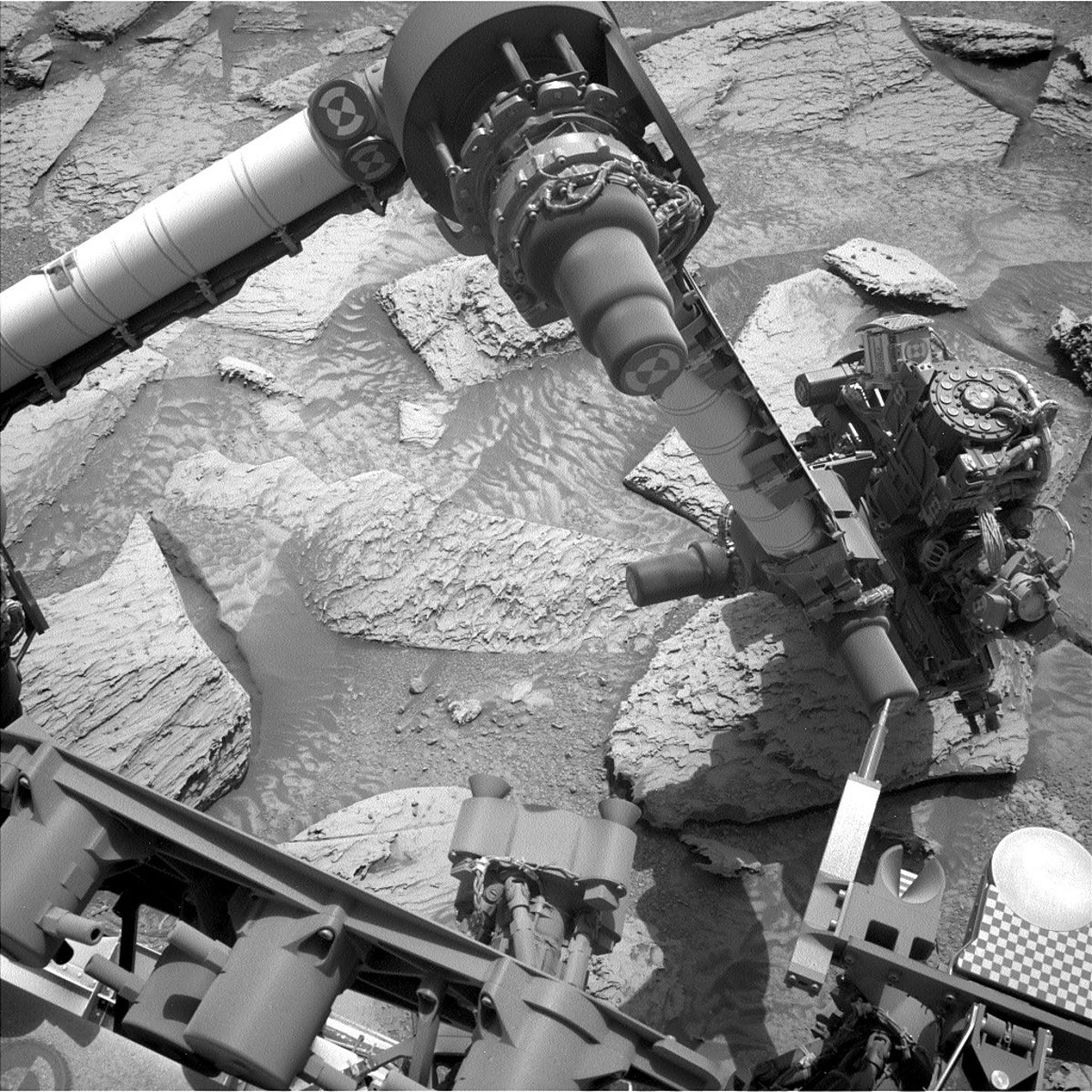
"The problem started on April 25. That date was supposed to be Curiosity's second day of drilling into a 28.6-pound, 1.5-foot-wide, six-inch-thick rock called Atacama. But as the rover attempted to pull out its drill arm, the rock came up with it, having gotten lodged onto the sleeve that surrounds the tool's bit."
"Back on Earth, Curiosity's human controllers first tried to just shake the rock loose, like a parent trying to free a child with their hand stuck in the cookie jar, but that didn't work. Then the controllers tried vibrating the drill to knock the rock loose and had no luck. Finally, on May 1, they tilted and rotated the drill while spinning the bit and, after a few tries, the rock came loose."
"Debris from the rock will be analyzed by Curiosity's Chemistry and Mineralogy (CheMin) instrument and compared with samples taken at another site, Mineral King, located nearly 525 feet below the rover's current location. With the tool free, Curiosity can continue exploring Mars's Gale Crater, where it has spent the past 14 years."
NASA's Curiosity Mars rover encountered a mechanical problem on April 25 when its drill became stuck in a 28.6-pound rock called Atacama during a drilling operation. The rock lodged onto the sleeve surrounding the drill bit, preventing the rover from retracting its arm. Controllers attempted multiple solutions: shaking the rock loose, vibrating the drill, and finally tilting, rotating, and spinning the drill bit simultaneously. On May 1, the rock broke free and fell to the ground in smaller pieces. The debris will be analyzed by Curiosity's Chemistry and Mineralogy instrument and compared with samples from another site called Mineral King. With the drill now functional, Curiosity can continue its 14-year exploration mission in Gale Crater, including monitoring atmospheric dust and studying cloud movements on Mars.
Read at www.scientificamerican.com
Unable to calculate read time
Collection
[
|
...
]