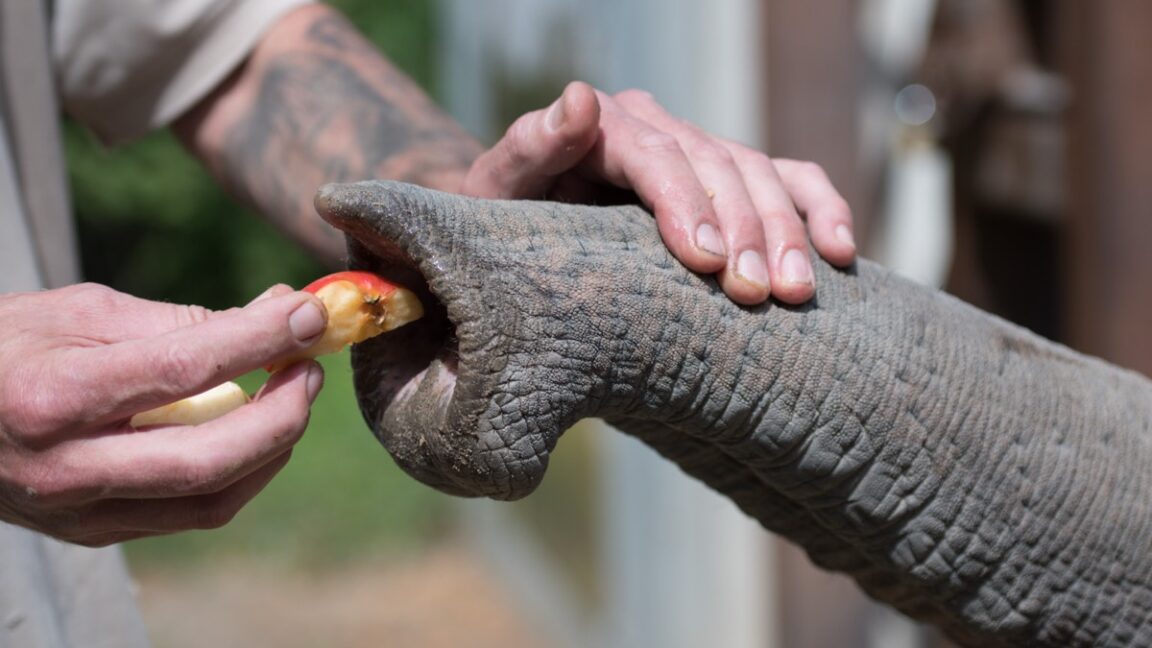
"An elephant's trunk is a marvelous thing, flexible enough to bend and stretch as it forages for food, but also stiff enough to grasp and maneuver even delicate objects like peanuts or a tortilla chip. That's because the trunk is highly sensitive when it comes to sensing touch. Scientists have determined that the whiskers lining the trunk are crucial for that sensitivity thanks to their unique structure, amounting to a kind of innate "material intelligence, according to a new paper published in the journal Science."
"As previously reported, there is a long history of studying whiskers ( vibrissae) in mammals. Rats, cats, tree squirrels, manatees, harbor seals, sea otters, pole cats, shrews, tammar wallabies, sea lions, and naked mole-rats all share strikingly similar basic whisker anatomies, according to various prior studies. Among other potential applications, such research could one day enable scientists to build artificial whiskers as tactile sensors in robotics, as well as learn more about human touch."
"Whiskers are much more complex than one might think, both in structure and function. Rats, for instance, have about 30 large whiskers and dozens of smaller ones, part of a complex "scanning sensorimotor system" that enables the rat to perform such diverse tasks as texture analysis, active touch for path finding, pattern recognition, and object location, just by scanning the terrain with its whiskers."
Whiskers lining the elephant trunk provide crucial tactile sensitivity through a specialized structure that functions as a form of innate material intelligence. Many mammals share similar whisker anatomies, including rats, cats, tree squirrels, manatees, harbor seals, sea otters, pole cats, shrews, tammar wallabies, sea lions, and naked mole-rats. Whiskers are keratin hairs whose sensitivity arises from follicles connected to dense neural structures. Each rat whisker inserts into a follicle linked to a barrel containing as many as 4,000 neurons, forming a topographic map that conveys object identity and movement. Whisker arrays enable texture analysis, navigation, pattern recognition, and object localization; artificial whiskers could inform robotics and human touch research.
Read at Ars Technica
Unable to calculate read time
Collection
[
|
...
]