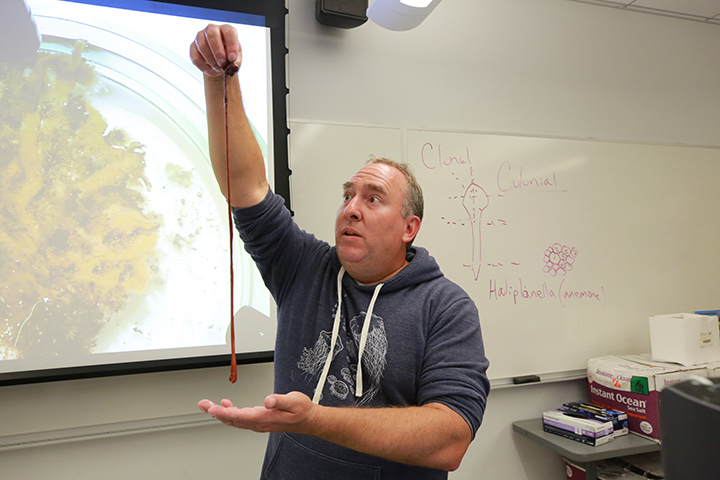
"Sometime in the late 1990s, an adult ribbon worm was scooped up from the murk in the waters off the San Juan Islands, in the Pacific Northwest. He was moved to a tank along with a smattering of other invertebrates, including two vermilion bat stars and approximately 30 beige peanut worms. In the years since, the worm has been transported across the country to Virginia, where he lives now."
"The ribbon worm-recently dubbed Baseodiscus the Eldest, or B for short-was just confirmed to be the longest-lived ribbon worm in the world. His persistence extends the previously known maximum lifespan of such worms (three years) by an order of magnitude, per a short communication in the Journal of Experimental Zoology Part A: Ecological and Integrative Physiology. (Ribbon worms have separate sexes, and although B has not been definitively tested, researchers suspect the worm is male due to what appear to be numerous testes.)"
""We tend to be kind of biased towards like things with bones and things that look like us in terms of complexity in different ways," said Chloe Goodsell, a PhD student at UC Irvine and an author on the paper. "Most of the extremely long-lived organisms on Earth are invertebrates," she added, pointing to giant clams, which can reach 100 years, and tube worms, which can reach 250 years."
A ribbon worm collected in the late 1990s from waters off the San Juan Islands has lived in captivity for at least 26 years, likely around 30, surviving in a tank through moves to Virginia. The specimen, now called Baseodiscus the Eldest (B), has been confirmed as the longest-lived ribbon worm on record, extending the previously known maximum lifespan from three years to decades. Ribbon worms have separate sexes, and B is suspected male due to apparent testes. Many extremely long-lived animals are invertebrates, with examples including giant clams (up to 100 years) and tube worms (up to 250 years). Ribbon worms can also reach great lengths.
Read at Defector
Unable to calculate read time
Collection
[
|
...
]