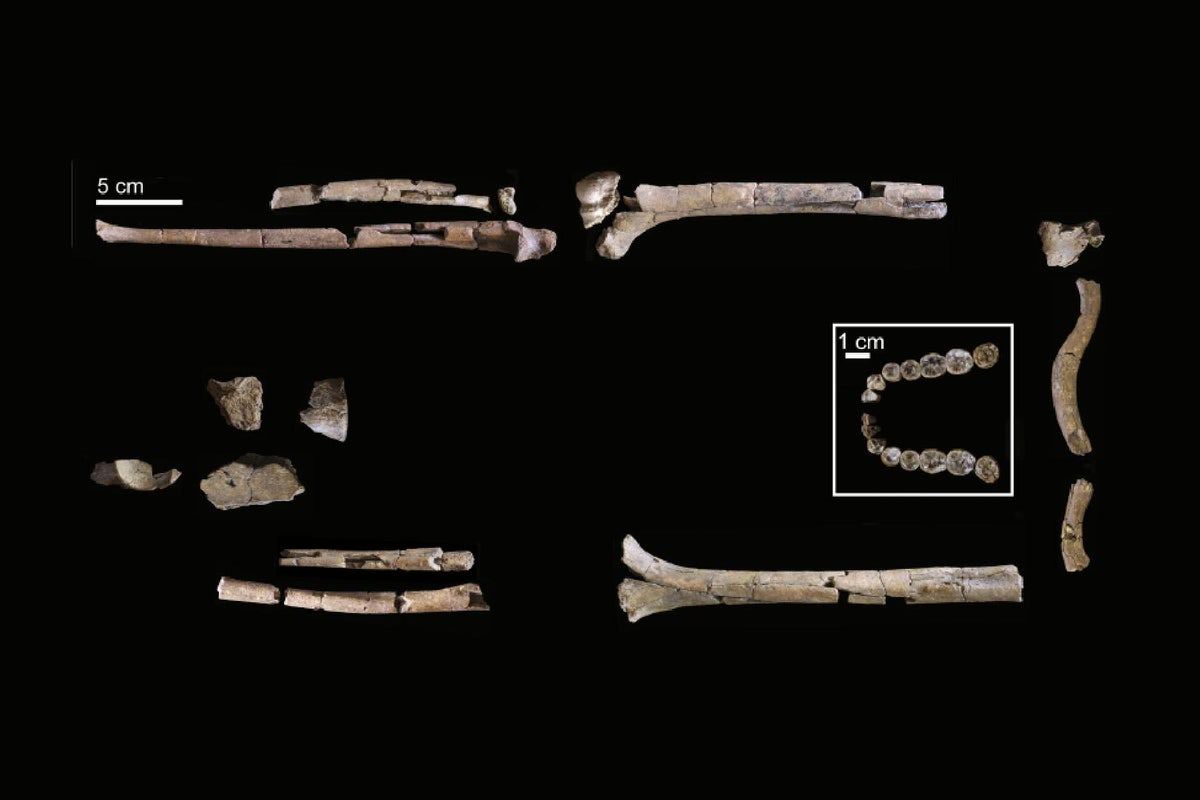
"A skeleton found in the Lake Turkana Basin area of northern Kenya is the most complete set of remains ever found of Homo habilis, a species that was one of the earliest members of the Homo genus and lived more than two million years ago. Its large brain and flat faceattributes found in today's humanshave long set the species apart from earlier hominins such as Australopithecus africanus."
"A new study analyzing the uniquely complete skeleton, however, suggests H. habilis' body looked much less modern. The analysis of the bones, published on January 13 in the Anatomical Record, affirms previous assumptions about the species, such as that H. habilis had long and strong arms that were more similar in proportion to those of apes than to those of modern humans."
"Additionally, H. habilis was smallperhaps even smaller than Lucy, a 3.2-million-year-old hominin specimen known for her tiny size. A finding like this does give hope, says William Harcourt-Smith, a paleoanthropologist at the American Museum of Natural History, who was not involved in the study. It's been tough with Homo habilis, as there are very limited, scrappy remains. It shows us that hard work in the field, and constantly looking for them, reaps important dividends."
A nearly complete Homo habilis skeleton from the Lake Turkana Basin reveals a body that retained primitive, ape-like proportions despite the species' relatively large brain and flat face. Bone analysis confirms long, strong arms more similar in proportion to apes than to modern humans and indicates small overall body size, possibly smaller than the 3.2-million-year-old Lucy specimen. Some teeth were first found in Lake Turkana sediments in 2012, and a trail of bone fragments led downslope to larger upper-body bones. The fully excavated remains include lower teeth, both collarbones, both upper arm and forearm bones, and shoulder fragments.
Read at www.scientificamerican.com
Unable to calculate read time
Collection
[
|
...
]