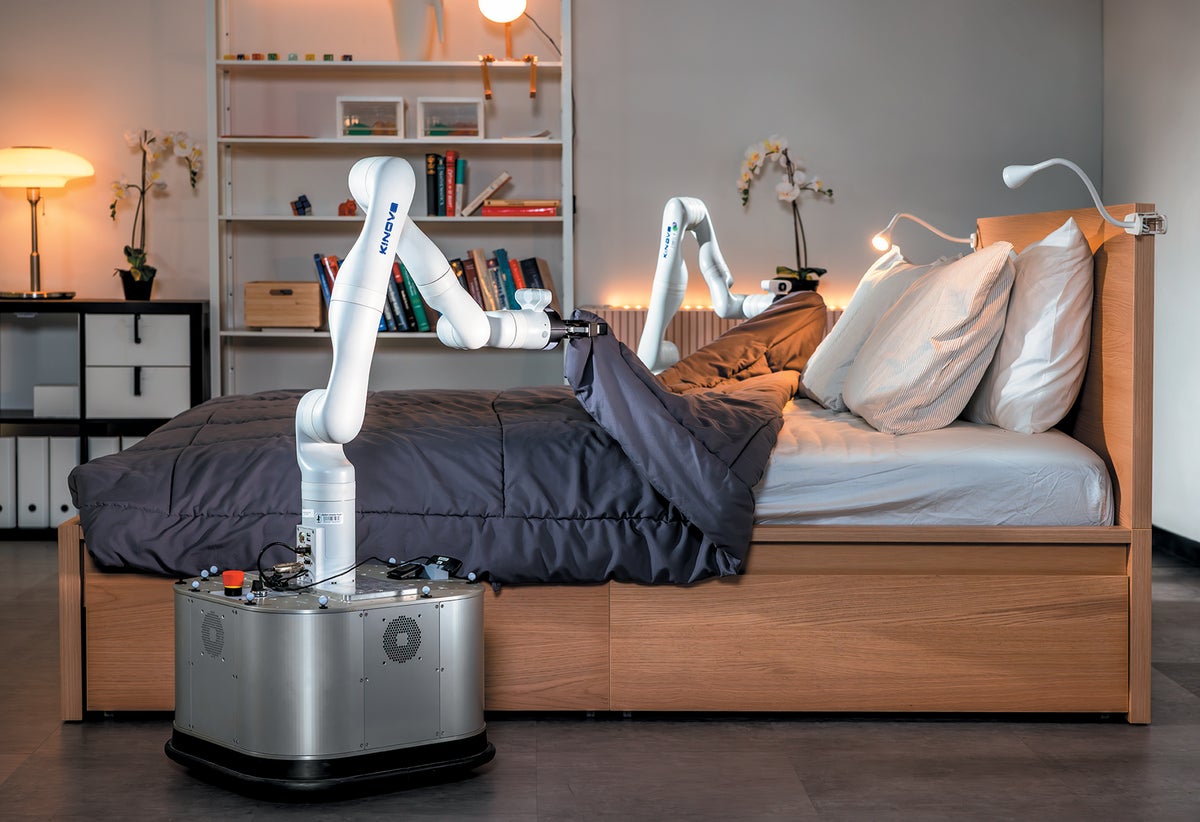
Future domestic and industrial robots could assist with caregiving, cleaning, and assembly, lifting elderly people, dressing them, picking up toys, and assembling complex electronics. Some such machines exist as prototypes while others remain theoretical. Engineers target tasks that involve friction, inconvenience, or inaccessible environments. Realizing these roles requires robots to manage human unpredictability by being flexible, navigating messy and changing settings, and operating safely around children and frail older adults. Robots need sturdy, dexterous manipulators mounted on stable chassis with reliable power sources. Affordability is also essential to widespread adoption, making development technically and economically challenging.
"In the future, a caregiving machine might gently lift an elderly person out of bed in the morning and help them get dressed. A cleaning bot could trundle through a child's room, picking up scattered objects, depositing toys on shelves and tucking away dirty laundry. And in a factory, mechanical hands may assemble a next-generation smartphone from its first fragile component to the finishing touch."
"These are glimpses of a possible time when humans and robots will live and work side by side. Some of these machines already exist as prototypes, and some are still theoretical. In situations where people experience friction, inconvenience or wasted effort, engineers see opportunityfor robots to perform chores, do tasks we are unable to do or go places where we cannot. Realizing such a future poses immense difficulties, however, not the least of which is us."
"Human beings are wild and unpredictable. Robots, beholden as they are to the rules of their programming, do not handle chaos well. Any robot collaborating or even coexisting with humans must be flexible. It must navigate messes and handle sudden changes in the environment. It must operate safely around excitable small children or delicate older people. Its limbs or manipulators must be sturdy, dexterous and attached to a stable body chassis that provides a source of power."
Read at www.scientificamerican.com
Unable to calculate read time
Collection
[
|
...
]