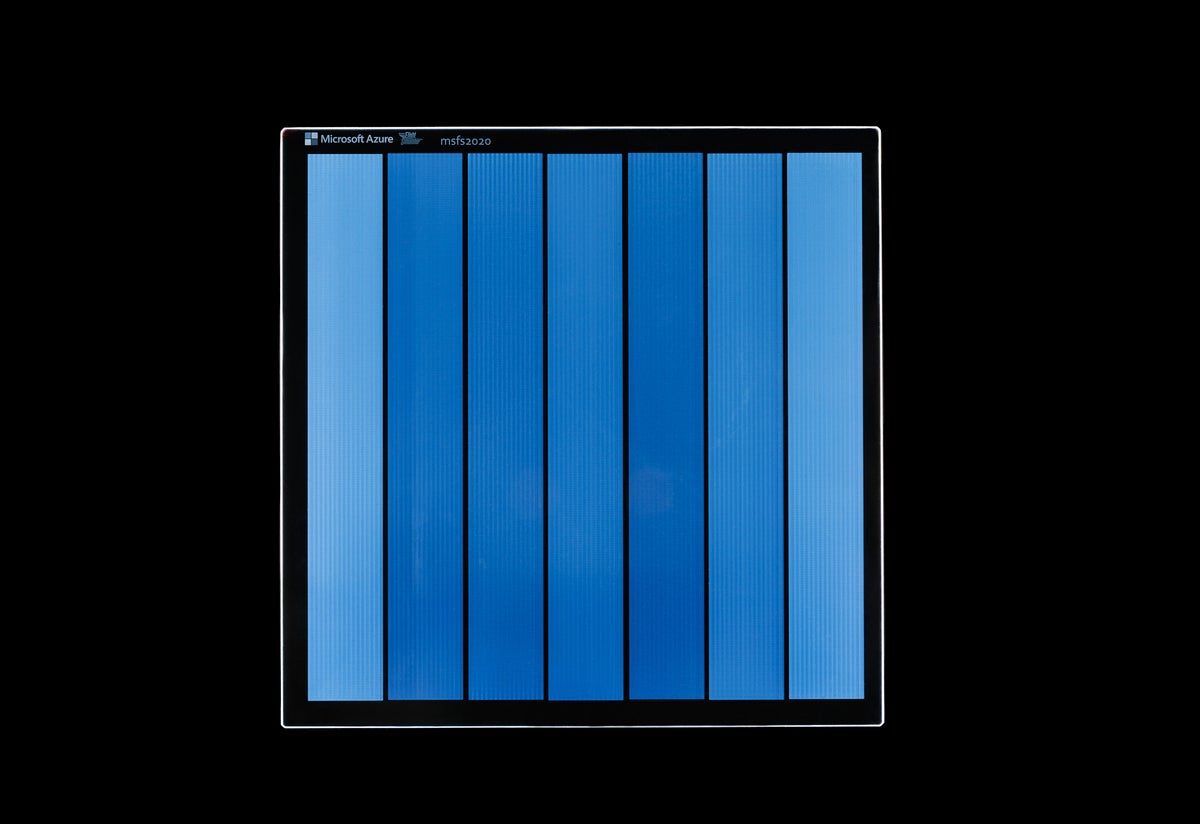
"A team at Microsoft Research combined lasers, machine learning and tiny glass rectangles to demonstrate a new robotic data storage system that could, in theory, still be readable 10,000 years from nowtwice as long as humans have been writing things down to date. The process, described recently in Nature, is designed for archiving records that don't need to be accessed often, such as certain climate measurements, historical records and other reference materials."
"The new system can write, read and store 4.8 terabytes of data in a minuscule piece of glass with a surface of 12 centimeters squared and a thickness of two millimeters. It crams that much information into such a small space by etching 301 layers of three-dimensional pixel-like holes called voxels stacked on top of one another."
"To record information, a laser zaps data into precise depths of the glass using a series of energy pulses that each last for about one quadrillionth of a second. Filling the glass book with data requires 48.9 kilojoules of energy, or about the calories contained in half a brussels sprout."
"This is an exciting and very promising development, says Doris Moncke, a glass chemist and an associate professor for glass science at Alfred University in New York State, who wasn't involved in the study. They sure went farther than anything I have seen recently at glass conferences."
A Microsoft Research team combined lasers, machine learning and tiny glass rectangles to build a robotic data storage system capable of remaining readable for up to 10,000 years. The system encodes 4.8 terabytes in a 12 cm², 2 mm-thick glass piece by etching 301 stacked layers of voxel-like holes. Lasers deliver ultrashort pulses—about one quadrillionth of a second—to write data, requiring 48.9 kilojoules to fill a glass "book." Reading focuses a microscope on each layer and uses machine learning to interpret images into symbols. The technology targets seldom-accessed archives like climate measurements and historical records and could scale to vast glass libraries.
Read at www.scientificamerican.com
Unable to calculate read time
Collection
[
|
...
]