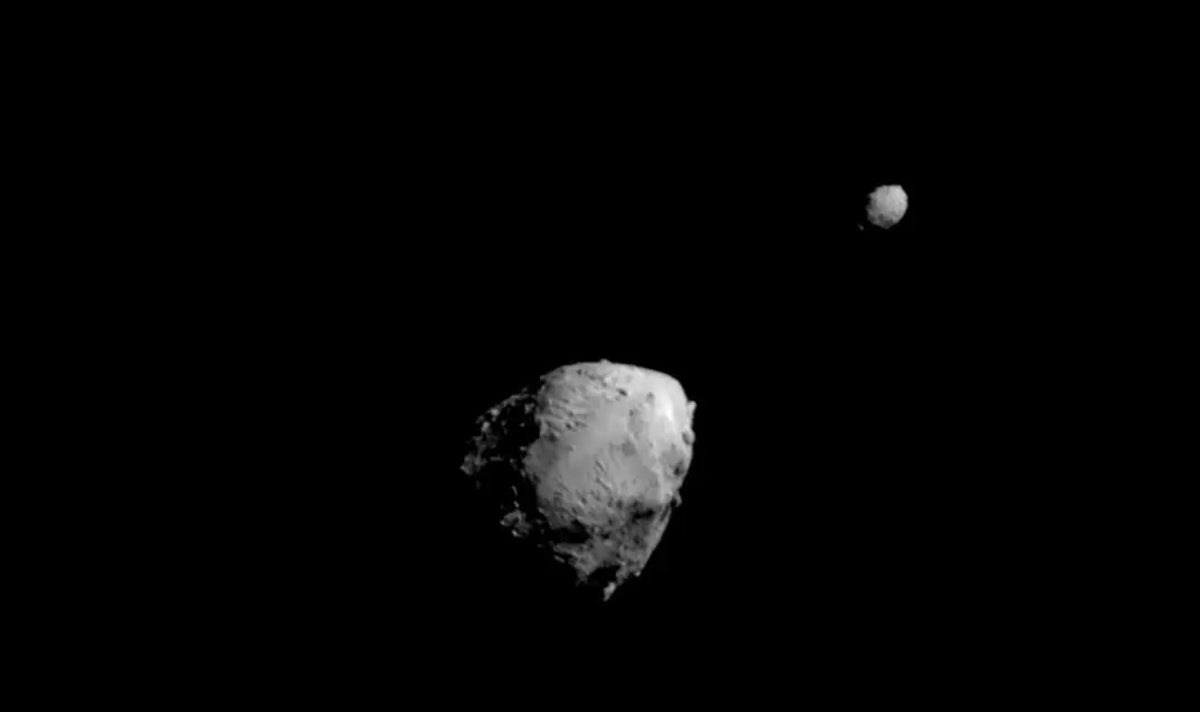
"By slowing Dimorphos's orbit, NASA has managed to alter the entire binary system's orbit around the sun. The act of changing a natural object's orbit around our home star marks a first for humanity. In a study published on Friday in the journal Science Advances, researchers explain how the original collision with Dimorphos slowed the entire binary's solar orbit by around 12 microns per second."
"If [an asteroid] is ever on its way to hitting the Earth, we can more confidently now say that we have the ability to push them around and away from the Earth, says the study's lead author Rahil Makadia, who was a planetary defense scientist at the University of Illinois Urbana-Champaign when it was conducted."
"DART involved ramming a 570-kilogram spacecraft moving at some 22,530 kilometers an hour into Dimorphos in a bid to slow its journey around Didymos. Dimorphos and Didymos don't pose a danger to Earth. But they were chosen as the targets for the Double Asteroid Redirection Test (DART) to assess our planetary defense capabilities."
In September 2022, NASA's DART spacecraft collided with Dimorphos, a small asteroid orbiting the larger asteroid Didymos. The impact slowed Dimorphos's orbit around Didymos by approximately 30 minutes. More significantly, research published in Science Advances reveals the collision altered the entire binary system's orbit around the sun by roughly 12 microns per second, marking the first time humanity has changed a natural object's solar orbit. This achievement demonstrates the viability of kinetic impact as a planetary defense strategy. Scientists can now more confidently state that deflecting potentially hazardous asteroids away from Earth is feasible, providing crucial data for future asteroid mitigation efforts.
Read at www.scientificamerican.com
Unable to calculate read time
Collection
[
|
...
]