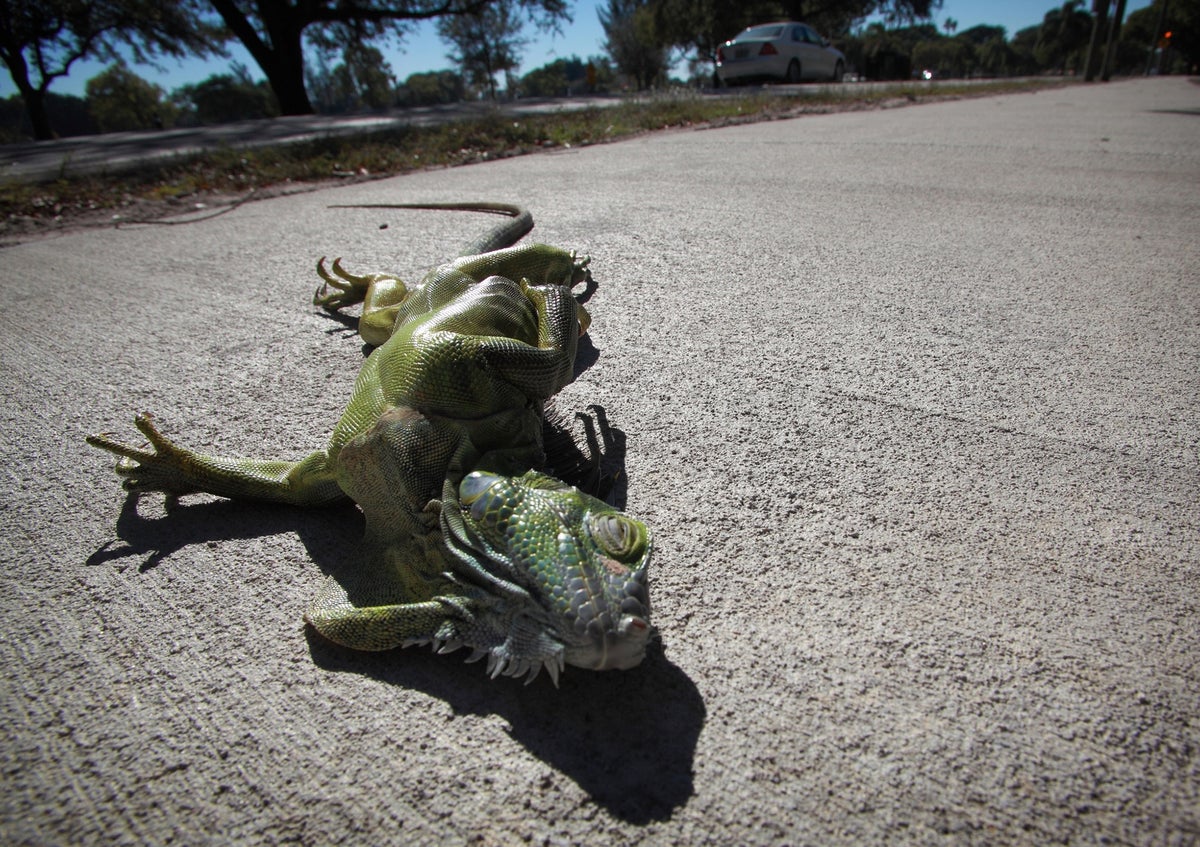
Florida hosts established populations of non-native green iguanas introduced in the 1960s. These tropical reptiles thrive in warm conditions but become susceptible to cold shock when temperatures fall below about 50°F (10°C). Cold-shocked iguanas often fall from trees during cold snaps, a phenomenon linked to sudden overnight lows that can reach the 30s or 20s Fahrenheit in parts of the state. Green iguanas evolved in stable Central and South American rainforests and lack adaptations for freezing or near-freezing temperatures. Occasional cold events in Florida provide opportunities to study how species respond when confronted with climates outside their evolutionary experience, with implications for invasive species dynamics and climate-change impacts.
"Green iguanas (Iguana iguana) are not native to the U.S. but were brought to Florida in the 1960s, where they have, for the most part, flourishedexcept, that is, when temperatures have dropped below 50 degrees F (10 degrees C). These chilly conditions can cause a cold shock in the lizards. And because the iguanas tend to sleep in trees, getting cold shocked can sometimes cause the animals to fall from the skies in an infamous Florida phenomenon."
"The animalswhich can reach more than five feet in lengthare native to rainforests in Central and South America, where temperatures are far more consistent than they are in Florida. These tropical lizards were experiencing conditions that they've never experienced in their entire evolutionary history before, tens of millions of years, says James Stroud, an evolutionary biologist at the Georgia Institute of Technology."
Read at www.scientificamerican.com
Unable to calculate read time
Collection
[
|
...
]