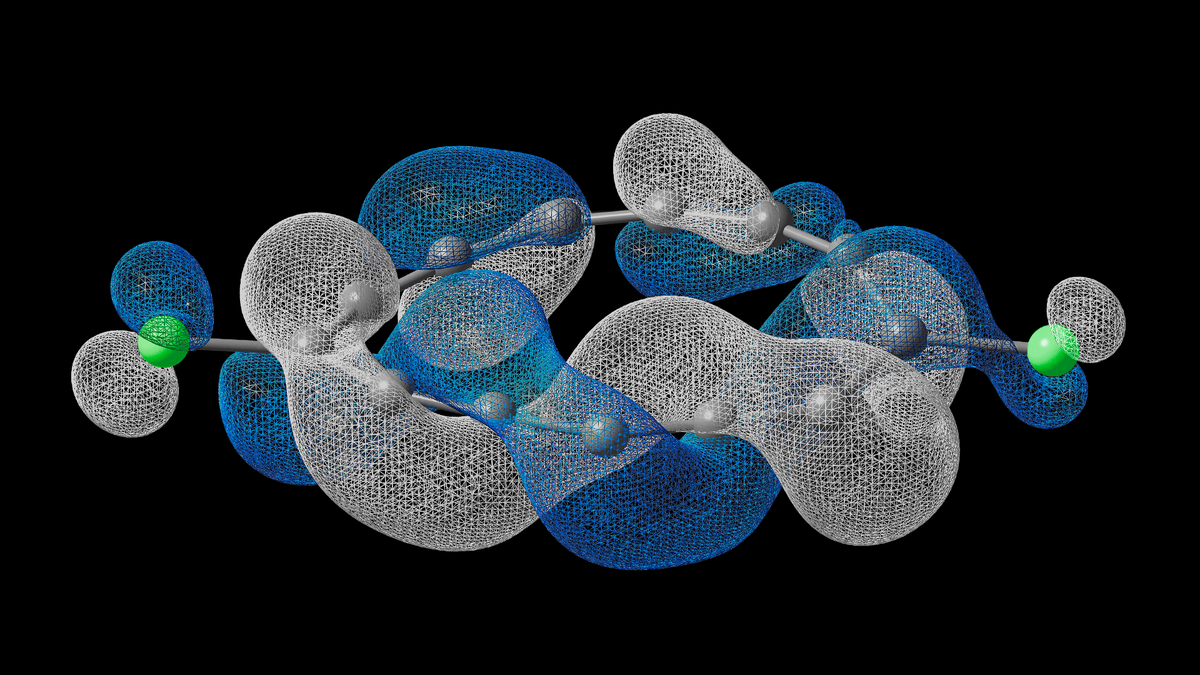
"Scientists have just created a new, strange type of molecule. It's made of a bunch of atoms bound together in a ring, like many other, simpler molecules. But if you could somehow zoom in on the electrons zipping about the atoms, you'd see that their motion around the ring had become weird and twisty. Those twists form a new structure akin to the famously mind-bending one-sided, one-edged Mobius strip but even more complicated."
"The team, based at IBM Research, engineered this molecule by manipulating individual atomic bonds and then imaged it with high-powered microscopy. The researchers also confirmed what they were seeing with the power of IBM's state-of-the-art quantum computers. Their work was published today in Science."
"The fact that such a molecule has not only been theoretically proposed but has actually been synthesized will have a major impact on the field of molecular science, says Yasutomo Segawa, a researcher at the Institute for Molecular Science in Japan, who was not part of the team's work."
IBM Research scientists have synthesized an unprecedented ring-shaped molecule featuring unusual electron motion patterns that form structures analogous to a Möbius strip but significantly more complex. Using atomic manipulation techniques and high-powered microscopy, the team engineered the molecule by precisely controlling individual atomic bonds. Quantum computers verified their observations, confirming the theoretical predictions. This breakthrough represents the first physical realization of such a molecular structure, advancing topological chemistry—the study of strangely shaped molecules exhibiting bizarre quantum behaviors. The achievement demonstrates quantum computers' capability to simulate and study subatomic phenomena, marking a significant milestone in molecular science with potential implications for future research.
#topological-chemistry #quantum-computing #molecular-engineering #atomic-manipulation #mobius-strip-molecules
Read at www.scientificamerican.com
Unable to calculate read time
Collection
[
|
...
]