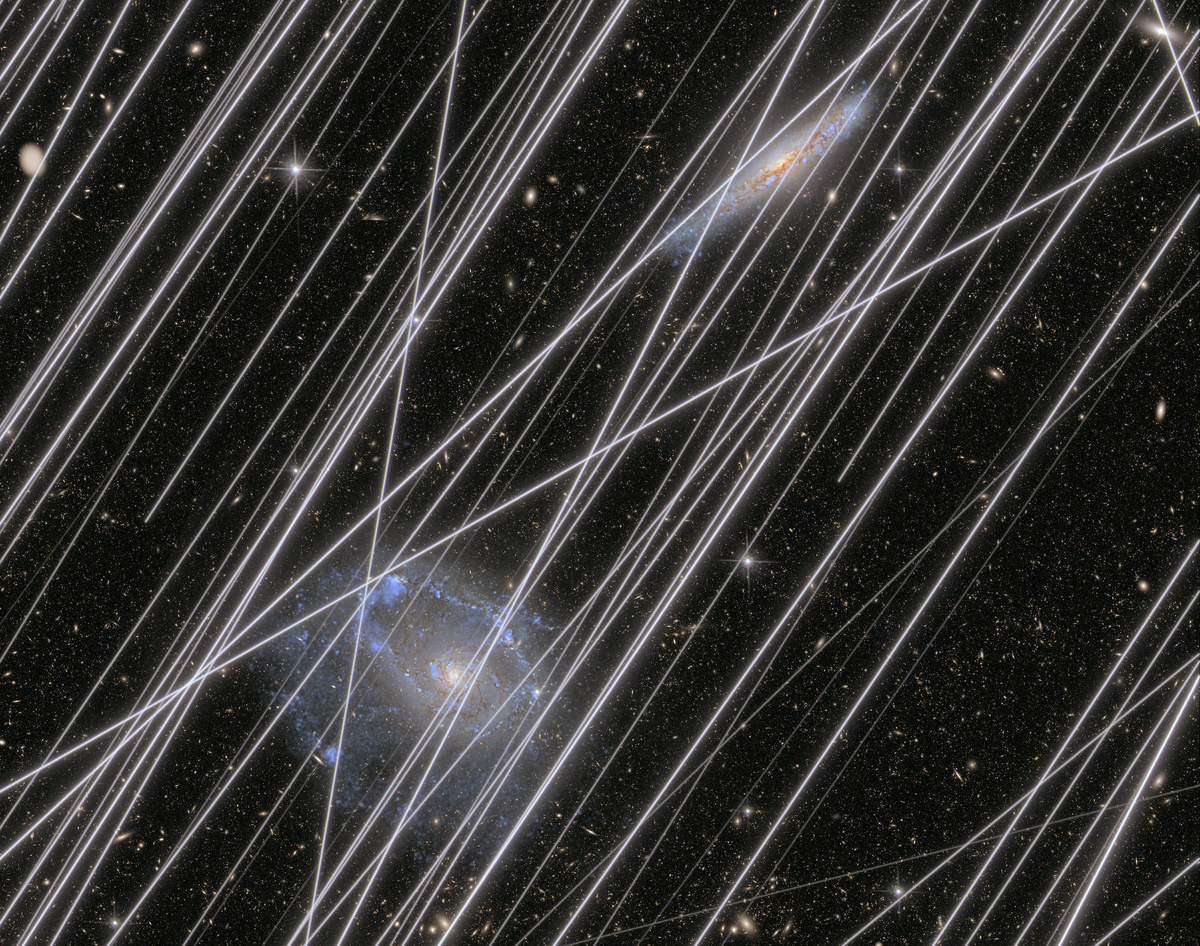
Thousands of active satellites circle Earth and frequently produce streaks that photobomb astronomical telescopes. Ground-based observatories like the Vera C. Rubin Observatory have suffered visual interference, and space-based telescopes including Hubble are beginning to experience the same problem. If companies implement planned launches, Earth's orbit could host about 560,000 satellites by the late 2030s, many organized into megaconstellations of hundreds or thousands serving purposes such as global broadband. New estimates indicate at least one satellite from such swarms could appear in one out of every three Hubble images, while other observatories may record traces in nearly every exposure. The resulting light pollution is already appearing in astronomy data and distracting researchers, and the situation will worsen without a solution.
"Today the globe is circled by thousands of active satelliteseach prone to photobombing astronomers' telescopes as an artificial star zipping across the night sky. Scientists working with ground-based observatories such as the cutting-edge Vera C. Rubin Observatory have long worried about this visual interferencebut as satellites continue to proliferate, space-based telescopes, including the beloved Hubble Space Telescope, are beginning to suffer, too. And the problem is only going to get worse."
"If companies follow through on their stated launch plans, Earth's orbit will be home to some 560,000 satellites by the end of the 2030s. Many of these will be members of megaconstellationsgroups of hundreds or thousands of satellites that all operate toward some common purpose, such as providing global broadband Internet from orbit. And according to new estimates published on December 3 in Nature, at least one satellite from such swarms could appear in one out of every three images captured by Hubble."
"Other observatories that the researchers analyzed will see traces of these satellites in nearly every individual exposure. There's no hard line at which satellite interference makes science impossible, but the light pollution created by megaconstellations is already showing up in astronomy data and distracting people who are trying to investigate the mysteries of the cosmos, says Alejandro Borlaff, an astrophysicist at NASA's Ames Research Center in California and a co-author of the new research."
Read at www.scientificamerican.com
Unable to calculate read time
Collection
[
|
...
]